


Data transparency in ESG has become a critical component of modern corporate strategy. Companies no longer make vague sustainability promises. They now supply stakeholders with data that is quantitative, verifiable, and accessible. This trend reflects the increasing need for ESG data openness in global markets. Investors, regulators, and customers require businesses to demonstrate their environmental and social effect. As a result, companies must have clear reporting mechanisms to ensure responsibility. Transparent data promotes confidence. When organizations provide reliable sustainability statistics, stakeholders build trust in their pledges. This technique lowers uncertainty while strengthening long-term ties. Data openness in ESG promotes improved decision-making. Businesses may assess performance, discover gaps, and refine strategy. It helps businesses to connect operations with their sustainability aims.
Furthermore, openness deters greenwashing. Companies cannot hide behind deceptive statements when data is available and verifiable. This ensures ethical behaviour and responsible development. Businesses that embrace transparency in ESG reporting position themselves as sustainability leaders. The significance of data transparency in ESG will expand as global expectations shift.
Role of Digital Tools in Enhancing Data Transparency in ESG
Digital technologies are essential for boosting data transparency in ESG. Companies rely on innovative technology to efficiently gather, analyze, and communicate sustainability data. These tools include artificial intelligence (AI), blockchain, and cloud-based reporting systems. They guarantee that data is accurate, consistent, and accessible. This enables sustainable data management across complicated corporate activities. Artificial intelligence enables businesses to process massive datasets fast. It recognizes patterns and abnormalities in ESG performance. This feature improves corporate accountability data by assuring correctness. Blockchain technology provides an additional layer of transparency. It generates secure and tamper-proof records for transactions and supply chain activity. This avoids manipulation and increases trust.
Cloud systems provide for real-time reporting. Stakeholders may get updated ESG data at any time. This increases both communication and decision-making. Businesses that use digital technologies increase ESG data transparency and efficiency. These technologies also cut reporting expenses and inaccuracies. In a competitive market, organizations who use digital solutions have an advantage. They exhibit a commitment to openness and accountability. As a result, openness in ESG data has emerged as a critical driver of long-term corporate performance.

Preventing Greenwashing Through Data Transparency in ESG
Greenwashing is a significant issue in sustainability. Companies frequently overestimate their environmental initiatives without presenting evidence. Data transparency in ESG solves this issue by encouraging honesty and responsibility. When companies provide reliable data, stakeholders may check their assertions. This decreases the possibility of false information. Transparent reporting ensures that corporations are held responsible for their activities. Businesses must produce measurable outcomes rather than imprecise assertions. This improves transparency in ESG reporting and trustworthiness. Stakeholders can compare performance between firms and industries. This promotes competitiveness and constant progress.
Regulators also help to avoid greenwashing. They compel corporations to report standardised ESG data. This provides consistency and dependability. Organizations that use data transparency in ESG comply with legislation and avoid legal concerns. Furthermore, openness improves business credibility. Customers and investors trust companies that give clear and reliable data. This trust leads to long-term loyalty and growth. Data transparency in ESG not only helps to combat greenwashing, but it also promotes ethical business practices and sustainable growth.
Traditional ESG Reporting vs Transparent ESG Reporting
| Feature | Traditional ESG Reporting | Data Transparency in ESG |
|---|---|---|
| Data Access | Limited | Open and accessible |
| Accuracy | Inconsistent | Verified and reliable |
| Accountability | Low | High corporate accountability data |
| Stakeholder Trust | Moderate | Strong trust and credibility |
| Risk of Greenwashing | High | Low due to transparency |
Traditional ESG reporting is typically unclear and inconsistent. Companies may give partial or out-of-date information. In contrast, ESG’s data transparency assures real-time, accurate data exchange. This enhances decision-making and stakeholder confidence. Transparent reporting also increases accountability. Companies must accept responsibility for their performance. This promotes constant development and innovation. By implementing data transparency in ESG, firms get a competitive edge in global marketplaces.
Benefits of Data Transparency in ESG
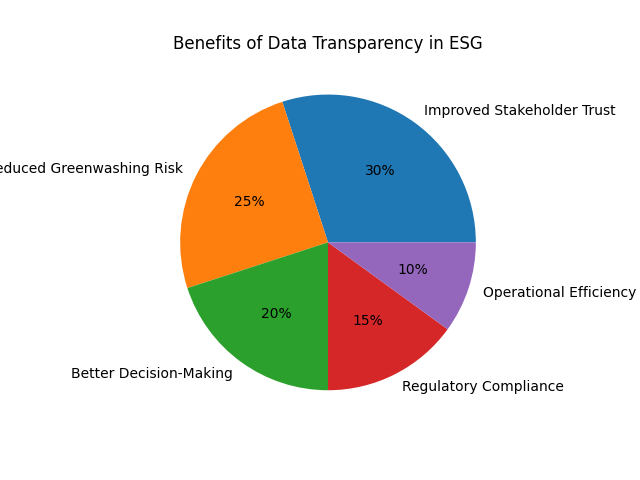
This pie chart shows how data transparency in ESG improves corporate success. Stakeholder trust provides the most advantage. This emphasizes the value of honesty in developing successful connections. Reduced greenwashing risk also plays an important effect. The figure demonstrates how openness benefits a variety of corporate tasks. Companies may enhance performance while remaining compliant. Organizations gain long-term development and resilience by prioritizing ESG data openness.
Strategies to Implement Data Transparency in ESG
Companies must use effective measures to ensure data transparency in ESG. First, they should create unambiguous reporting structures. These frameworks specify which data to gather and how to show it. This provides consistency and dependability. Organizations must also invest in digital technologies for managing sustainability data.
Second, organizations should educate staff about ESG reporting. Skilled teams can gather and evaluate data efficiently. This increases accuracy and decreases mistakes. Companies should also work with external auditors. Independent verification improves corporate accountability data and increases confidence.
Third, organizations must engage their stakeholders. They should convey ESG performance clearly and consistently. This transparency strengthens connections and invites feedback. Companies may successfully exchange data by using dashboards and reports.
Companies that use these tactics improve data openness in ESG. They promote responsibility, mitigate risks, and achieve long-term growth. Transparency becomes a competitive advantage in today’s businesses.
Future of Data Transparency in ESG and Responsible Business
The future of data transparency in ESG is inextricably related to technology advancement and global sustainability objectives. Companies will continue to use innovative tools to increase data accuracy and accessibility. This will improve transparency in ESG reporting and encourage ethical corporate behavior. Regulatory obligations would also grow. Governments will require uniform ESG reporting. This ensures uniformity across sectors. Companies who adopt Data Transparency in ESG early will have a competitive edge. They will increase trust and attract investment.
Innovation will drive the development of innovative data management systems. Artificial intelligence and blockchain will increase openness and accountability. These technologies will improve ESG reporting efficiency and reliability. Businesses will incorporate sustainability data into their basic operations. To summarize, data openness in ESG is critical for the future of responsible business. It promotes trust, prevents greenwashing, and encourages long-term growth. Companies that embrace transparency will drive the next wave of sustainable development and corporate responsibility.
Global platforms such as the World Economic Forum emphasize the importance of reliable ESG data in driving transparency and sustainable business decisions.