



Sustainable business practice are transforming the way businesses function in today’s competitive global marketplace. In Norway, corporations are balancing profit with environmental and social responsibilities. This move reflects Norway’s rising emphasis on sustainable business models that favor long-term value above short-term benefits. Companies are using responsible measures to decrease their environmental effect while enhancing operational efficiency. These activities contribute to both economic growth and sustainability. Norwegian organizations recognize that sustainability is no longer an option. Investors, regulators, and consumers need openness and responsibility. Companies that apply sustainable business practice gain credibility and improve their market position. This strategy also promotes innovation and resource optimization. Businesses may minimize waste while also lowering expenses and increasing productivity.
The Norwegian business ecosystem promotes sustainability via strong governance and legislation. Companies gain from clear legislation and access to innovative technology. These elements help organizations to successfully implement green business strategies in Norway. As a result, Norway has emerged as a global leader in sustainable growth. Sustainable business practices continue to generate long-term success and resilience in today’s modern economy.
ESG Integration in Sustainable Business Practice
Environmental, social, and governance concerns are central to sustainable business practice in Norway. Companies incorporate ESG issues into their basic strategy to increase openness and responsibility. This integration supports Norway’s ESG policies, which emphasize environmental responsibility, ethical governance, and social impact. Businesses that use ESG guidelines have a competitive edge in global marketplaces. Organizations utilize ESG reporting systems to measure performance and achieve sustainable objectives. These systems collect information on emissions, energy usage, and workforce diversity. Companies may use this data to make informed decisions that line with Norway’s goals for sustainable growth. ESG integration also helps risk management by highlighting possible environmental and social issues.
Investors are increasingly relying on ESG criteria to evaluate firms. Transparent reporting boosts confidence and encourages prudent investing. Sustainable business practices backed by ESG frameworks improve stakeholder connections and corporate reputation. Companies that focus on ESG are better positioned for long-term success. Norway’s regulatory structures push enterprises to embrace ESG norms. This atmosphere guarantees that sustainability becomes an integral component of company strategy. As a consequence, sustainable business practices based on ESG integration continue to influence Norway’s commercial future.
Resource Efficiency and Green Innovation in Norway
Resource efficiency is a crucial component of Norway’s sustainable business practices. Companies concentrate on increasing energy efficiency, decreasing waste, and improving industrial processes. These activities contribute to Norway’s green business objectives by reducing environmental effect while preserving productivity. Businesses utilize modern technology to track resource use and detect inefficiencies. Innovation is critical to accomplishing sustainable development goals. Norwegian firms spend in R&D to generate environmentally friendly solutions. This strategy promotes clean technology and renewable energy, hence driving Norway’s long-term corporate prosperity. Organizations use smart systems to increase efficiency and minimize operational expenses.
Resource efficiency improves competitiveness. Companies that use less resources can offer items at a reduced price while retaining quality. This advantage enhances their standing in global marketplaces. Businesses may balance revenue and environmental responsibility by adopting sustainable business practices. Furthermore, innovation fosters collaboration between companies and research organizations. These collaborations help to speed the creation of long-term solutions. Norway’s dedication to innovation keeps enterprises at the forefront of global environmental trends. Companies that prioritize resource efficiency gain long-term growth and resilience.

Traditional vs Sustainable Business Strategies
| Feature | Traditional Business | Sustainable Business Practices |
|---|---|---|
| Focus | Profit only | Profit + sustainability |
| Resource Use | High consumption | Efficient resource use |
| Risk Management | Reactive | Proactive ESG practices Norway |
| Innovation | Limited | Continuous green innovation |
| Growth | Short-term | Long-term sustainable growth Norway |
Traditional corporate strategies frequently prioritize short-term profitability over environmental effect. In contrast, sustainable business practices include sustainability into all aspects of operations. This strategy boosts efficiency while lowering dangers. Companies that implement sustainable methods get long-term rewards. They strengthen ties with stakeholders and improve their reputation. Norway’s focus on green business practices creates benefits beyond financial achievement. This comparison demonstrates why sustainability is more important for modern organizations. Sustainable business practices offer a framework for meeting both economic and environmental objectives.
Real-World Examples of Sustainable Business Practices in Norway
Several Norwegian enterprises have demonstrated the usefulness of sustainable business methods. Equinor, for example, has integrated renewable energy solutions into its operations. The firm invests in offshore wind farms and using digital techniques to maximize energy output. These programs promote sustainable growth in Norway and minimize carbon emissions.
Another example is Yara International, which promotes sustainable agriculture. Yara employs cutting-edge technologies to increase fertilizer efficiency while minimizing environmental effect. The company’s activities are consistent with ESG principles in Norway and encourage responsible resource usage.
These firms show how Norway’s sustainable business strategies mix innovation with sustainability. They show that business and environmental responsibility can coexist. Organizations that implement Sustainable Business Practices gain long-term growth and resilience.
Norway’s business environment pushes enterprises to innovate and implement sustainable practices. This environment encourages cooperation and ongoing progress. As a result, Norwegian firms continue to be global leaders in environmental initiatives.
Impact of Sustainable Business Strategies
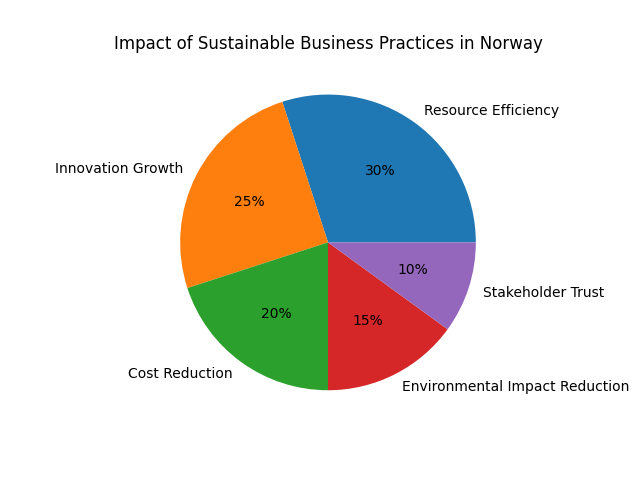
This pie chart highlights how sustainable business strategies help businesses succeed. The most significant advantage is resource efficiency, which emphasizes the necessity of lowering costs and environmental effect. Innovation growth is also important in achieving long-term success.
The graphic indicates that sustainability solutions offer several benefits. Companies may boost performance while also promoting environmental aims. Norwegian firms achieve balanced growth by using green business strategies.
FAQs
What are Sustainable Business Practices?
They are strategies that integrate environmental, social, and economic goals into business operations.
2. Why is Norway a leader in sustainable business?
Norway supports innovation, strong governance, and ESG practices Norway.
3. How do sustainable strategies improve growth?
They reduce costs, improve efficiency, and enhance brand reputation.
4. What role does ESG play in sustainability?
ESG frameworks guide companies in managing environmental and social responsibilities.
5. Can small businesses adopt sustainable practices?
Yes, they can implement resource efficiency and ethical strategies easily.
Future of Sustainable Business Practices in Norway
The future of sustainable business practices in Norway is bright, as firms continue to innovate and adapt. Businesses are anticipated to increase their investments in renewable energy, digital technology, and effective resource management. These actions will increase Norway’s long-term growth and competitiveness.
Technological improvements will play a significant part in determining sustainability. Companies will employ data analytics and automation to improve operations. This method promotes Norway’s sustainable business by increasing efficiency and lowering environmental effect. Organizations will also prioritize circular economy concepts to reduce waste.
Government policies will continue to promote sustainable practices. Regulations and incentives will encourage green business initiatives in Norway across industries. Businesses will set goals that coincide with national sustainability targets.
In conclusion, sustainable business practices are critical for long-term success. Companies that prioritize sustainability will shape the future of global business. Norway’s dedication to innovation and responsibility keeps its firms at the forefront of sustainable development.