


The world is using more materials than ever before, but the majority of them end up being squandered. According to contemporary statistics, more than 90% of all mined and processed resources end up as waste or emissions. This disturbing trend highlights the unsustainable nature of the old “take-make-dispose” economy. Circular economy 2025 provides a promising alternative: a system that lowers waste, preserves value, and secures long-term consumption and production cycles. Circular economy encourages manufacturers, firms, and consumers to reconsider products from design to disposal. Under this approach, materials are used for as long as feasible, design encourages reuse/repair, and recycling becomes the norm, moving the focus from unending consumption to sustainable resource use.
In this article, we look at circular economy models, contemporary recycling advances, environmentally conscious consumer habits, company reforms, and initiatives for creating a more sustainable global system by 2026.
Understanding Circular Economy Models in 2025
Circular economy 2025 stresses models that disrupt the linear economy’s waste cycle. Reuse and refurbishment, product-as-a-service, and closed-loop manufacturing are three key techniques. Electronics, furniture, and clothes are fixed or refurbished instead of being thrown in reuse/refurbishment models. This increases product longevity and conserves resources. The product-as-a-service concept replaces ownership with access: customers lease or share things rather than purchasing them. This lowers excess output and encourages effective consumption. Closed-loop manufacturing guarantees that end-of-life items are disassembled and recycled to recover raw materials, lowering dependency on virgin resources and decreasing waste.
As a result, the circular economy calls into question traditional industrial and consuming practices. Companies must plan for durability, recyclability, and modularity. Consumers must adopt new habits that prioritize repair, reuse, sharing, or services over possession. This transition is required for the development of sustainable systems.
Recycling Innovations & Technological Advances
A critical component of Circular Economy 2025 is the use of innovative technology to increase recycling and trash management. Advances in chemical and mechanical recycling, artificial intelligence-aided garbage sorting, and waste-to-resource technologies are transforming how societies deal with waste. For example, chemical recycling degrades polymers and synthetic materials into their original monomers, allowing for nearly limitless reuse, which was previously impossible. Start-ups are also working on enzyme-based ways to depolymerize difficult-to-recycle plastics, allowing for the recycling of mixed or contaminated waste streams.
On the mechanical/automated end, AI-powered sorting systems utilize computer vision and robots to properly identify garbage, significantly increasing recycling efficiency and minimizing contamination. These breakthroughs make the circular economy of 2025 more than just a pipe dream: recycling becomes efficient, scalable, and commercially practical. They also aid in the recovery of important resources (such as metals and rare earths) from e-waste and outdated goods, hence minimizing the need for new mining.
Circular Supply Chains & Business Transformation
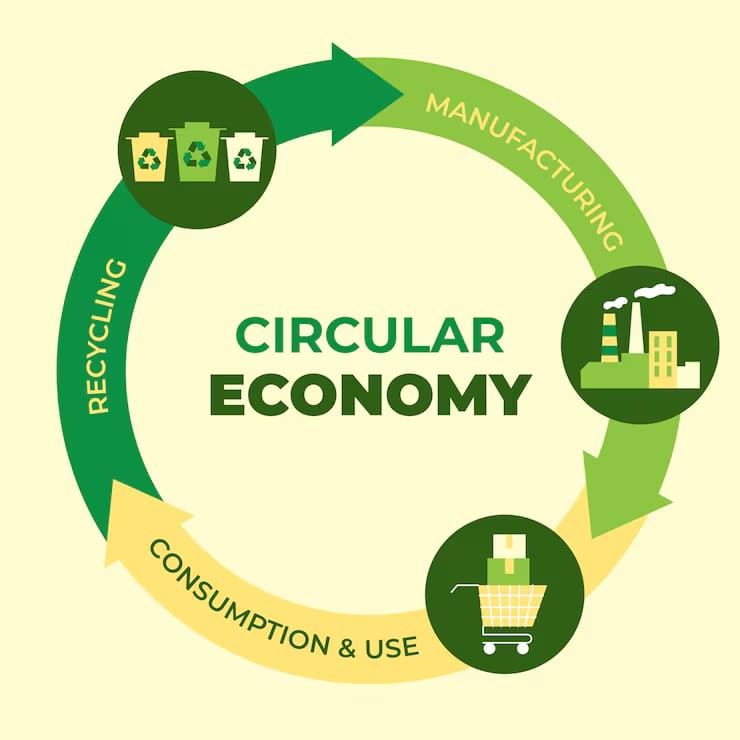
To succeed with circular economy 2025, logistics networks must be redesigned. Traditional linear supply chains extract, manufacture, consume, and dispose. Circular supply chains reverse the flow by recovering, recycling, refurbishing, and reintroducing commodities into manufacturing cycles. Businesses are progressively implementing extended producer responsibility (EPR), take-back programs, and design-for-repair/product passports. These activities assist to guarantee that items do not wind up in landfills but are returned, reconditioned, or repurposed. Companies that use recycled or secondary materials save money, minimize their carbon footprint, and boost their brand image.
Furthermore, circular supply chains promote resilience. When raw material costs vary or supply is limited, circular sourcing provides a cushion by depending on recycled inputs. As the worldwide demand for sustainability grows, firms who comply with Circular Economy 2025 have a competitive edge.
Eco-Conscious Consumer Behavior & Sustainable Consumption
Consumers are crucial to circular economy 2025. Eco-conscious decisions create demand for circular products and shape manufacturing patterns. This includes favoring long-lasting things, purchasing reconditioned items, choosing sharing services over ownership, and supporting firms that adhere to circular practices.
Consumers are increasingly opting to repair their electronics, utilize refillable packaging, and avoid single-use plastic. The increased knowledge of environmental issues drives up demand for transparency, recyclability, and ethical sourcing. Brands that respond with clear circular strategy earn loyalty and confidence.
Policymakers and non-governmental organizations (NGOs) also advocate for behavior change by supporting reuse, recycling, sharing economies, and secondhand marketplaces. When consumer behavior is consistent with circular principles, the waste-to-wealth paradigm becomes practical. Circular economy 2025 relies greatly on such transformations in public perception.
Comparison: Linear vs Circular Economy 2025
| Aspect / Outcome | Linear Economy | Circular Economy 2025 Approach |
|---|---|---|
| Resource Use | High virgin material extraction | Use of recycled/secondary materials |
| Waste & Pollution | High waste, landfill, emissions | Waste minimized, materials reused |
| Product Lifespan | Short, planned obsolescence | Extended life, repair/refurbish |
| Economic Value | One-time sale | Multiple life cycles, value retention |
| Environmental Impact | High carbon + resource footprint | Lower emissions, resource efficiency |
| Supply Chain Resilience | Vulnerable to resource scarcity | Robust via closed-loop supply |
Challenges to Circular Economy 2025 & How to Overcome Them
Transitioning to a circular economy by 2025 poses challenges. First, the worldwide circularity rate remains low. For example, even in places with sophisticated recycling, just 12.2% of materials used in the EU in 2024 were recycled. That implies more than 87% of materials are virgin or discarded, demonstrating how far transformation must go. Furthermore, consumer habits, planned obsolescence, low-cost virgin materials, inadequate waste-segregation infrastructure, and a lack of incentives impede circular adoption. Innovative recycling systems may require significant investment and scale to become cost-effective.
To address these issues, governments and businesses must implement supporting policies such as extended producer responsibility, recycling technology subsidies, bans or levies on single-use or non-recyclable packaging, and transparent circular product labeling. Public awareness initiatives and incentives for recycling or reuse also assist to change consumer behavior. Collaboration among stakeholders (governments, industry, consumers, and NGOs) is essential.
Global Trends & The Future Outlook for Circular Economy 2025
According to recent assessments from prominent organizations, circular economy 2025 is gaining popularity, notably in materials-intensive industries such as electronics, plastics, and textiles, as well as waste-management innovation. Plastic-to-plastic recycling, chemical depolymerization, automated sorting, and digital tracking (product passports, blockchain traceability) are all fast expanding technologies. These advancements promise to progressively bridge the “circularity gap,” in which only a tiny percentage of materials are currently recirculated.
At the same time, consumers’ desire for sustainability is growing. Businesses use circular models not only for ethical reasons, but also to save money, increase brand value, and build resilience. Circular approaches are expected to become more common as restrictions tighten and environmental awareness develops.
Conclusion
Circular economy 2025 provides a practical, systematic path away from wasteful linear consumption. By rethinking design, manufacturing, use, and disposal, we may develop systems in which materials last longer, waste is reduced, and environmental impact is minimized. Recycling innovations, supply chain restructuring, and consumer behavior are all key components of this shift. The path ahead is difficult: established systems, economic models, and consumer habits are resistant to change. However, with concerted efforts — regulatory backing, business accountability, technology innovation, and consumer awareness — the circular economy 2025 might gradually gain traction. As we reach 2026, the choice is clear: continue on the road of waste and depletion, or embrace sustainable cycles, resource efficiency, and circular life. Circular economy 2025 urges each of us to make sensible decisions.