


The world is running out of time. With 2030 approaching fast, the gap between where we are and where the Sustainable Development Goals (SDGs) need us to be is significant. Traditional methods are not cutting it. That is exactly why SDG innovation for sustainable development has become one of the most urgent conversations in business, policy, and technology circles today.
Innovation, in this context, is not just about new gadgets or startup ideas. It is about fundamentally rethinking how we solve problems — from energy access and food security to climate action and economic equality. When innovation is aligned with the SDGs, it becomes a powerful lever for global change.
Moreover, the stakes could not be higher. Over 700 million people still live in extreme poverty. Climate-related disasters are intensifying every year. Without smarter, faster solutions, we will simply not meet these goals. That is why innovation is not optional — it is critical.
What Is SDG Innovation?
SDG innovation refers to the development and application of new ideas, technologies, and business models that directly accelerate progress toward the UN’s 17 Sustainable Development Goals.
It sits at the intersection of three forces:
- Technology — tools like AI, blockchain, and clean energy systems
- Policy — regulatory frameworks that enable or restrict sustainable solutions
- Business models — new ways of creating value without depleting natural or social resources
Importantly, SDG innovation is not limited to high-tech solutions. A community-led water management system in rural Kenya is just as much an innovation as a satellite-powered agricultural monitoring tool. The key question is: does it move the needle on a specific SDG?
Furthermore, the UN’s SDG framework specifically highlights the need for innovation through Goal 9 — Industry, Innovation, and Infrastructure. This signals that innovation is not a byproduct of sustainable development; it is a prerequisite. To understand how the SDGs are structured and measured, it also helps to explore SDG reporting and investments as a foundation.
Role of Technology in SDG Innovation
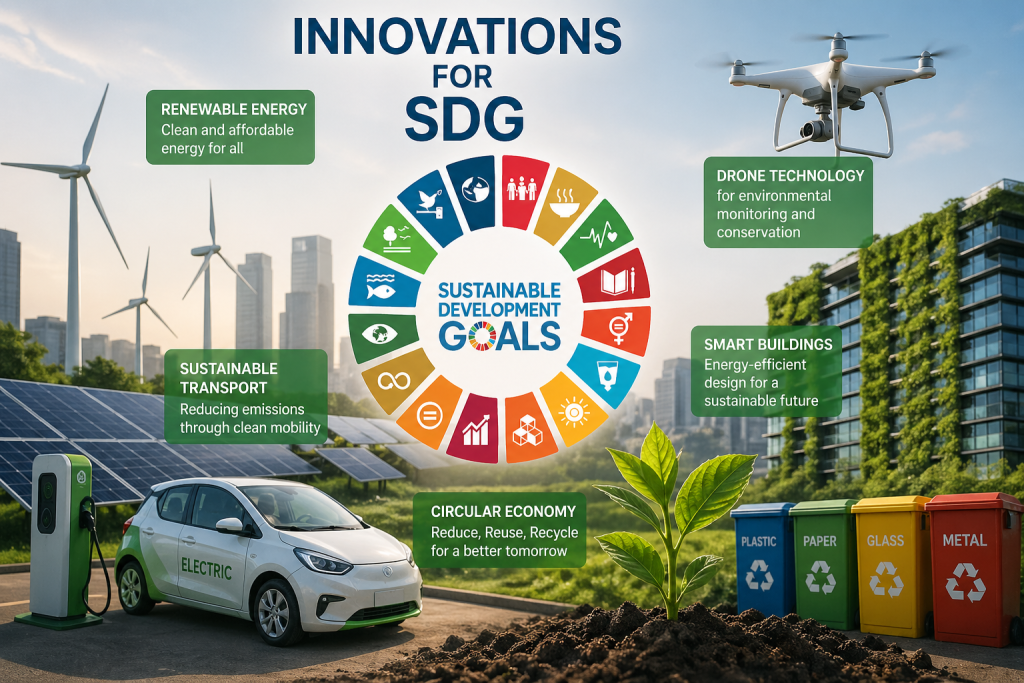
Technology is arguably the most visible driver of SDG innovation for sustainable development. Across sectors, digital tools are transforming what is possible.
Artificial Intelligence is being used to model climate scenarios, predict crop failures, optimize energy grids, and detect illegal deforestation in real time. The World Resources Institute uses AI-powered satellite imagery to track global forest cover — data that was previously impossible to gather at scale.
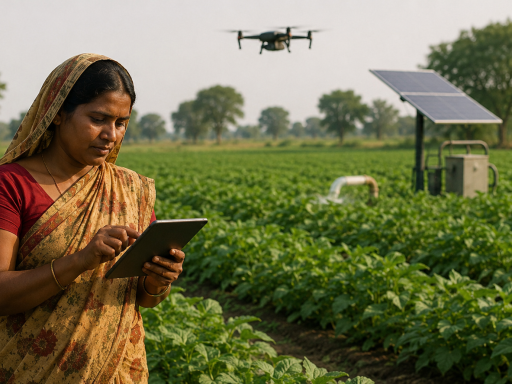
IoT (Internet of Things) connects physical infrastructure to digital systems. Smart water meters, connected soil sensors, and real-time air quality monitors help cities and farmers make decisions based on live data rather than guesswork.
Data analytics allows governments and organizations to identify where SDG gaps are widest — and direct resources accordingly. For instance, health ministries in several African countries use mobile data to map disease outbreaks and allocate medical supplies before situations escalate.
Digital transformation, therefore, is not just a business trend. It is a sustainability tool. As explored in the intersection of sustainability and digital transformation, this connection is becoming increasingly central to SDG strategy.
Business Innovation for Sustainable Development
The private sector is stepping up — and not just for PR purposes. Genuine business innovation is reshaping how companies contribute to sustainable development.
One of the most impactful shifts is the rise of the circular economy. Instead of the traditional “take-make-dispose” model, circular businesses design products for reuse, repair, and recycling. This directly supports SDG 12 (Responsible Consumption and Production) while also reducing costs and waste.
Green innovation is another growing area. Companies like Tesla, Ørsted, and Patagonia have built entire business models around sustainability. Meanwhile, thousands of startups are attacking niche problems — from biodegradable packaging to carbon-negative concrete.
Startups, in particular, play a disproportionate role. Because they are unburdened by legacy systems, they can experiment faster and take risks that larger corporations cannot. The result is a growing pipeline of scalable sustainability solutions emerging from the startup ecosystem.
The private sector also has something no government can easily replicate: capital at speed. When businesses align ESG strategies with SDG goals — as discussed in ESG business factors — investment flows toward impact. That is a game-changer.
How Innovation Accelerates SDGs Progress
Speed matters when you have a deadline. Innovation accelerates SDG progress in three concrete ways.
Faster implementation — Digital solutions scale in ways physical infrastructure cannot. A mobile health app can reach a million users in months. A new clinic takes years to build.
Cost efficiency — Innovative solutions often lower the cost per impact. Solar microgrids now provide electricity to remote communities at a fraction of what grid extension would cost. This makes SDG progress economically viable even in low-income contexts.
Solving complexity — Many SDG challenges are interconnected. Climate change affects food security, which affects poverty, which affects education. Innovation — especially systems thinking and data-driven approaches — helps policymakers and organizations tackle these interlocked problems simultaneously rather than in silos.
Challenges in SDG Innovation
Despite its promise, SDG innovation for sustainable development faces real and persistent barriers.
Funding gaps remain the biggest obstacle. Innovative sustainability projects — especially in early stages — struggle to attract investment because they are perceived as risky or unprofitable. Blended finance models are helping, but the gap is still enormous.
Lack of collaboration slows progress significantly. Too often, governments, businesses, and civil society operate in separate lanes. Innovation thrives at intersections — and those intersections require deliberate relationship-building and trust.
Technology access inequality is perhaps the most troubling challenge. The communities that need innovation the most — in sub-Saharan Africa, South Asia, and parts of Latin America — often have the least access to it. Without intentional efforts to close the digital divide, innovation could actually widen SDG gaps instead of closing them.
Real-World Innovation Examples
Mini Case Study — M-KOPA Solar (Kenya): M-KOPA Solar offers pay-as-you-go solar energy to off-grid households in East Africa. Customers pay small daily amounts via mobile money — making clean energy affordable without upfront costs. To date, the company has connected over 3 million homes. This is SDG 7 (Affordable and Clean Energy) delivered through innovation in finance, technology, and distribution.
Beyond this example, several global initiatives demonstrate innovation at scale:
- The Global Innovation Fund supports breakthrough solutions for the world’s poorest communities, from sanitation to digital finance.
- UNDP’s SDG Innovation Facility helps governments pilot and scale new approaches to stubborn development challenges.
- Public-private partnerships — like the one driving COVID-19 vaccine development through COVAX — show how cross-sector innovation can mobilize at historic speed when the will exists.
Future of SDG Innovation
Looking ahead, the future of SDG innovation for sustainable development is shaped by three major forces.
Emerging technologies — Quantum computing, advanced biotech, and next-generation renewable energy (like green hydrogen) will unlock solutions we cannot yet fully imagine. These technologies are moving from lab to market faster than ever before.
Data-driven sustainability — The more we can measure, the more precisely we can act. Satellite data, real-time environmental sensors, and open data platforms are making it possible to track SDG progress at community level — not just national averages.
Global collaboration through innovation — Cross-border innovation partnerships are becoming normalized. Platforms like the UN SDG Partnership framework create shared infrastructure for countries and organizations to pool knowledge, funding, and technology. As highlighted in discussions around sustainable development goals broadly, the future belongs to those who collaborate across boundaries.
Conclusion
SDG innovation for sustainable development is not a luxury reserved for wealthy nations or technology giants. It is a necessity for every stakeholder — governments, businesses, communities, and individuals — who wants to see a just, livable world by 2030 and beyond.
The good news is that innovation is already happening at scale. Smart technologies, new business models, and cross-sector partnerships are delivering real results. However, without closing the funding gap, bridging the digital divide, and building genuine collaboration across sectors, these efforts will remain fragmented.
The path forward requires collective action — not isolated breakthroughs. Every government that passes a smart climate policy, every business that reinvents its supply chain, and every community that adopts a local innovation is part of the same story.
The SDGs are ambitious by design. Achieving them demands that we be equally ambitious in how we innovate. The tools exist. The knowledge exists. What remains is the will to act — together, urgently, and at scale.