

Green technology in Norway has emerged as a key engine of economic modernization and long-term progress. Norway has traditionally balanced economic progress with environmental responsibility, but technology now accelerates that balance at an unprecedented rate. Businesses are investing in renewable infrastructure, digital sustainability systems, and emission-reduction technology to link business and climate goals. Economic development is being realized while environmental hazards are strategically mitigated. This dual outcome characterizes the current Norwegian growth model.
Norway’s sustainability innovation is seen in the energy, infrastructure, and digital sectors. Clean technology Norway projects are transforming corporate planning frameworks. Sustainable investments are governed by quantifiable climate goals. The Norwegian technology ecosystem promotes scalable climate solutions. As a consequence, green technology in Norway builds resilience, increases investor confidence, and establishes the country as a global leader in sustainable economic growth.
Renewable Energy Leadership in Green Technology in Norway
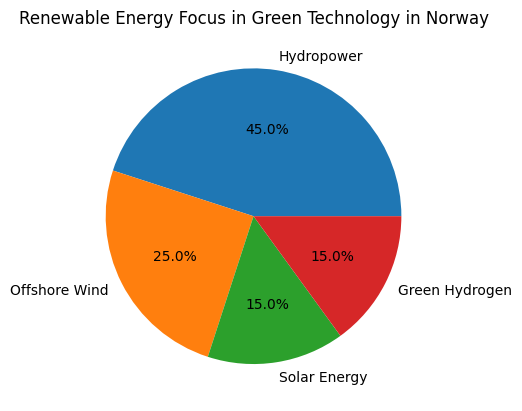
Renewable energy is the structural underpinning of green technology in Norway. Hydropower has powered the country for decades, but current innovation goes well beyond traditional energy sources. Offshore wind projects are quickly spreading throughout coastal regions. Solar technology are being tailored to Nordic environments through efficiency enhancements. Green hydrogen generation is being tested in the heavy industrial and maritime sectors. These advances lower carbon intensity while increasing export prospects.
Government subsidies help to promote renewable energy growth. Public-private collaborations improve research and infrastructure development. Clean technology. Norway initiatives are frequently backed by robust policy frameworks that promote risk sharing and long-term planning. Investment in energy storage promotes grid stability. The pie chart above shows Norway’s renewable emphasis distribution. This diverse renewable portfolio demonstrates how Norway’s green technology promotes both long-term growth and global competitiveness.
Digital Sustainability and Smart Infrastructure Development
Digital innovation improves green technology in Norway by making sustainability quantifiable and actionable. Smart grids optimize power distribution in real time, reducing energy waste and increasing system resilience. Intelligent building systems automatically control lighting and heating, avoiding needless usage. Data-driven sustainability solutions collect environmental performance information on a continual basis. Emission trends are studied and corrected precisely.
The Norwegian technology ecosystem is critical to growing digital sustainability solutions. Climate analytics companies work with established enterprises. Digital dashboards promote operational transparency. Public infrastructure projects are integrating smart transportation networks to alleviate traffic congestion and pollution. These enhancements show how digital transformation and environmental stewardship are interrelated. Sustainable technology integration in Norway guarantees clear, efficient, and economically feasible progress.
Climate-Focused Startups and Norway Sustainability Innovation
A vibrant startup environment boosts green technologies in Norway by hastening climate innovation. Entrepreneurs are working on carbon capture devices, battery storage advancements, and circular waste solutions. Norway’s sustainability innovation thrives because to substantial venture capital funding and government incentives. Universities aggressively promote the commercialization of climate research. Startups frequently cooperate with larger organizations to explore scalable ideas. Pilot projects are rapidly implemented under supportive regulatory contexts. Clean technology initiatives in Norway gain traction through cross-sector cooperation. Innovation centers encourage experimentation and prudent scaling. This setting fosters risk-taking within acceptable limits. The proliferation of climate-focused businesses demonstrates that environmentally friendly innovations in Norway is not limited to established companies. It evolves on a constant basis using agile, data-driven, and sustainability-focused innovation approaches.

Policy Support and Corporate Responsibility Driving Clean Technology Norway
Policy frameworks are critical for fostering green technology in Norway. Clear national climate objectives drive company investment strategies. Carbon pricing schemes impact operational choices and encourage emissions reductions. Regulatory standards ensure environmental compliance across all businesses. Sustainable procurement policies increase demand for green solutions.
Corporate responsibility supplemented policy direction. ESG reporting has become common practice among big Norwegian corporations. Sustainability metrics are consistently tracked and disclosed in a transparent manner. Investors are increasingly prioritizing enterprises with environmental objectives. Public-private collaborations drive innovation while retaining accountability. Clean technology ventures in Norway benefit from clear legislative direction and financial incentives. This coordinated structure guarantees that sustainable methods in Norway stays credible, quantifiable, and strategically integrated into the larger economic system.
Economic Growth and Global Competitiveness Through Green Technology in Norway
Green technology has helped to diversify Norway’s economy. Reduced reliance on fossil fuel exports reduces long-term vulnerability. Renewable engineering, digital sustainability services, and climate analytics solutions are growing rapidly. Norwegian companies sell offshore wind knowledge and green hydrogen technology worldwide. The Norwegian technology ecosystem draws both competent workers and international investment. Workforce development initiatives prioritize renewable engineering and digital infrastructure capabilities. Clean technology Norway solutions improve worldwide brand trust. Traditional business paradigms are being increasingly replaced by more sustainable alternatives. As seen in previous comparisons, green models minimize risk while enhancing growth stability. Norway’s sustainability promotes robust economic growth and long-term international competitiveness by combining environmental stewardship with innovation.
Future Outlook for Green Technology in Norway
The future trajectory of green technology in Norway illustrates the ongoing combination of sophisticated innovation with climate responsibility. Artificial intelligence will improve renewable prediction accuracy. Digital sustainability systems will offer predictive environmental analytics. Offshore wind capacity is anticipated to increase further. Hydrogen exports may expand as infrastructure develops. Policy frameworks will most likely tighten to reach aggressive emission objectives. Transparent reporting requirements will develop alongside digital monitoring technologies. Curriculums in educational institutions are being aligned with the demands of climate engineering and sustainable design. International partnership will improve research and market access. Sustainability will continue to be a model of responsible economic growth thanks to ongoing improvement and smart investment. Innovation and environmental responsibility will continue to coexist within Norway’s sustainable economic ecosystem.
Real Time Examples in Norway
Equinor: Offshore Wind and Digital Carbon Tracking
The work of Equinor, the Norwegian energy giant that has evolved from a conventional oil and gas producer to a pioneer in low-carbon innovation, is one of the most notable instances of green technology in Norway. Equinor understands that clean and efficient energy systems are essential for the future. In order to do this, the corporation has made significant investments in offshore wind development, especially through initiatives like Hywind Scotland and Hywind Tampen, two of the first large-scale floating wind farms in history. By reducing reliance on fossil fuels and harnessing powerful offshore winds, these technologies support national climate targets and demonstrate how Norway can scale its sustainability innovation into global solutions.
Equinor also improves environmental performance and transparency by utilizing cutting-edge digital technologies. In order to track emissions from offshore activities in real time, the corporation has put digital carbon tracking technologies into place. These systems gather and analyze data using cloud platforms, artificial intelligence (AI) algorithms, and Internet of Things (IoT) sensors. Increased accountability is the direct outcome of thorough reporting that stakeholders can rely on. Equinor demonstrates how a heritage company may develop sustainably by fusing cutting-edge data analytics with green technology in Norway. Their initiatives provide both economic resilience and environmental benefits, demonstrating that, when led by creativity and openness, sustainable transitions are both feasible and lucrative.
Norsk Hydro: Recycled Aluminum and Circular Materials Solutions
One of Norway’s most prominent examples of green technology is Norsk Hydro, a multinational aluminum manufacturer that has made sustainability and circularity central to its business practices. For aluminum, a commodity that already has a great potential for recycling but frequently suffers from energy-intensive production methods, Norsk Hydro’s strategy focuses on developing a genuinely circular business model. Hydro created Hydro CIRCAL, a product line composed of a sizable amount of post-consumer recycled aluminum, in response. Compared to primary aluminum manufacturing, which is intrinsically carbon-intensive, Hydro significantly lowers emissions and energy consumption by utilizing recycled raw materials.
Additionally, Hydro has made investments in electronic systems that monitor the movement of materials along the supply chain. These systems gather information on energy usage, end-of-life recycling performance, and input quality. Sophisticated software systems then analyze this data to produce transparent ESG reporting, which clearly illustrates digital sustainability in an industrial setting. These projects show how companies may apply green technology in Norway to industrial transformation and materials innovation in addition to clean energy.
Hydro also works with outside partners to increase recycling infrastructure and encourage the global adoption of the circular economy. The company’s proactive approach demonstrates both a strong sense of corporate responsibility and Norwegian innovative ideals. Norsk Hydro demonstrates how sustainable technology solutions may transform conventional businesses and reduce environmental impact while preserving competitiveness and production quality with Hydro CIRCAL and its digital sustainability tools.
According to data from Statistics Norway (SSB), Norway continues to invest heavily in renewable energy, digital infrastructure, and innovation, reinforcing its position as a leader in sustainable business development.