

The world set an ambitious agenda in 2015. With 17 Sustainable Development Goals (SDGs) and a 2030 deadline, nations, corporations, and institutions committed to transforming life on Earth. But here is the uncomfortable truth: ambition without accountability rarely delivers results.
SDG accountability and governance sit at the core of whether this global promise becomes reality. Without structured oversight, transparent reporting, and enforceable frameworks, the SDGs risk becoming a list of aspirations rather than a roadmap for change. Moreover, the complexity of cross-border challenges — from climate action to poverty reduction — makes coordinated governance not just helpful, but essential.
This article explores how accountability mechanisms and governance structures shape SDG progress. It also examines what governments, businesses, and global institutions must do differently to close the gap between commitment and impact.
What Is SDG Accountability and Governance
SDG accountability refers to the systems, processes, and obligations that hold actors — governments, corporations, civil society — responsible for their commitments to the Sustainable Development Goals. Governance, in this context, describes the institutional structures and policy frameworks that guide how those commitments are planned, implemented, and monitored.
Together, they form the backbone of effective sustainable development. Without them, progress becomes difficult to measure, verify, or enforce.
Key concepts in this space include:
- Voluntary National Reviews (VNRs): Annual reports submitted by countries to the UN High-Level Political Forum, documenting SDG progress.
- Multi-stakeholder platforms: Mechanisms that bring governments, businesses, academia, and civil society into coordinated dialogue.
- Indicator frameworks: The UN’s 232 global indicators used to track progress across all 17 SDGs.
- Peer review mechanisms: Cross-country evaluations that promote shared learning and constructive accountability.
Governance frameworks like the Addis Ababa Action Agenda and the Paris Agreement complement SDG governance by aligning financial and climate systems with sustainable development objectives. You can explore how these interconnect with broader sustainability targets in this overview of SDG Reporting and Investments.
Role of Governments in SDG Accountability
Governments carry the primary responsibility for SDG accountability at the national level. Their role goes well beyond signing international agreements. Effective government involvement requires translating global goals into domestic policy, allocating budgets accordingly, and building the institutional capacity to monitor progress.
Policy implementation and monitoring demand that governments establish clear national SDG strategies. Countries like Finland and Denmark have integrated the SDGs directly into their national budgeting processes, making sustainability a fiscal priority rather than a communications exercise.
Regulatory frameworks are equally critical. Governments must create legal and regulatory environments that incentivize sustainable behavior — from carbon pricing mechanisms to mandatory environmental disclosures for large corporations.
National SDG reporting systems must be credible and data-driven. Many high-income countries have invested in National Statistics Offices to disaggregate SDG data by gender, region, and income group. This granularity enables more targeted interventions. However, lower-income nations frequently lack both the data infrastructure and the institutional capacity to sustain such systems.
Furthermore, parliaments play an underappreciated role. Legislative oversight — through budget reviews, committee hearings, and audits — adds a layer of accountability that executive agencies alone cannot provide. The SDG Goal 16: Peace, Justice and Strong Institutions specifically calls for transparent, effective, and accountable institutions at all levels.

Corporate Governance and SDGs
Businesses are no longer passive observers of the SDG agenda. Increasingly, they are expected — and in many jurisdictions, required — to demonstrate tangible contributions. Corporate governance structures directly shape how seriously companies take their sustainability responsibilities.
Business responsibility in SDG achievement has evolved significantly. Forward-thinking companies align their core strategies, supply chains, and product portfolios with specific SDGs. For example, a logistics company advancing SDG 13 (Climate Action) might commit to fleet electrification and scope 3 emissions reduction across its supply chain.
ESG reporting and compliance have become the primary accountability tool for the corporate sector. Frameworks like GRI (Global Reporting Initiative), SASB, and the recently implemented CSRD (Corporate Sustainability Reporting Directive) in the EU require companies to disclose environmental, social, and governance data against verified standards. This gives investors and regulators consistent, comparable information. Learn more about how ESG drives corporate value in this guide to the Business Value of ESG.
Ethical leadership and transparency determine whether corporate SDG commitments are genuine or performative. Boards that integrate sustainability into executive compensation, governance charters, and risk frameworks signal a structural commitment — not just a public relations one.
Mini Case Example — Unilever: Unilever’s Sustainable Living Plan, launched in 2010, explicitly linked its business growth targets to SDG-aligned goals around health, environmental footprint, and livelihoods. The plan tied executive bonuses to sustainability KPIs and published annual progress reports with third-party verification. While results were mixed, it demonstrated that embedding SDG accountability into corporate governance architecture produces more durable outcomes than voluntary pledges alone.
Importance of Transparency in SDG Progress
Transparency is not merely a governance virtue — it is a functional requirement for SDG accountability. Without open, accessible, and reliable data, it becomes impossible to assess whether progress is real or manufactured.
Open data and disclosure enable governments, researchers, journalists, and civil society organizations to independently verify SDG claims. Countries that publish disaggregated data — broken down by gender, age, ethnicity, and geography — allow for much sharper scrutiny than those that report aggregate national averages.
Building stakeholder trust depends on consistency between commitments and reported outcomes. When organizations publish transparent progress reports, they invite scrutiny — but they also earn credibility. Stakeholders, including investors, employees, and communities, increasingly reward transparency with trust and engagement. The link between transparency and sustainable outcomes is explored further in Transparency as Foundation of Sustainability.
Preventing greenwashing is one of transparency’s most critical functions. Greenwashing — the practice of exaggerating or fabricating sustainability claims — undermines SDG credibility across the entire ecosystem. Robust disclosure standards, third-party audits, and regulatory enforcement are the tools that separate genuine SDG action from empty marketing. For a deeper look at this challenge, read How Greenwashing Undermines Sustainability.
Challenges in SDG Accountability
Despite growing awareness, SDG accountability faces persistent and structural obstacles. Addressing these challenges honestly is the first step toward solving them.
Lack of standardization remains a significant problem. Different countries, companies, and institutions use different metrics, timelines, and methodologies when reporting on the SDGs. This fragmentation makes cross-country and cross-sector comparisons nearly impossible. Even within the UN system, inconsistent application of the 232 global indicators creates data gaps.
Data gaps and reporting issues disproportionately affect the countries that need accountability the most. Sub-Saharan Africa and parts of South Asia lack the statistical infrastructure to generate timely, high-quality data. Without reliable data, it is impossible to hold anyone accountable — and impossible to allocate resources effectively.
Weak enforcement mechanisms represent the most systemic challenge. The SDG framework is voluntary. No international body has the authority to sanction a government or corporation for failing to meet its commitments. Consequently, accountability depends heavily on political will, social pressure, and market incentives — all of which vary enormously across contexts.
Additionally, short political cycles create misalignment. Governments operate on 4–5 year electoral timelines. The SDGs, however, require sustained commitment across decades. This tension between short-term political incentives and long-term sustainability goals remains unresolved in most governance systems.
Global Frameworks Supporting SDG Governance
Several international frameworks provide the architecture through which SDG governance operates. These frameworks create shared standards, coordinate action, and hold actors to account across borders.
International sustainability standards from bodies like the International Sustainability Standards Board (ISSB) and the GRI provide common reporting languages for companies and governments alike. The ISSB’s IFRS S1 and S2 standards, now adopted in over 20 jurisdictions, represent a significant step toward consistent climate-related disclosure.
Role of global institutions — including the United Nations Development Programme (UNDP), the World Bank, and regional development banks — is to provide technical assistance, financing, and peer learning to countries working toward the SDGs. The UN’s High-Level Political Forum (HLPF) serves as the central accountability platform, where Voluntary National Reviews are presented and evaluated annually.
Cross-border collaboration is indispensable for SDGs that transcend national boundaries — ocean health, climate, biodiversity, and migration being prominent examples. SDG 17 specifically calls for global partnerships as a means of implementation. The Role of Partnerships in Achieving Sustainable Development Goals explores this dimension in detail.
Regional frameworks — such as the EU’s European Green Deal and the African Union’s Agenda 2063 — also play a vital governance role by translating global SDG commitments into regionally binding targets and accountability mechanisms.
Future of SDG Accountability and Governance
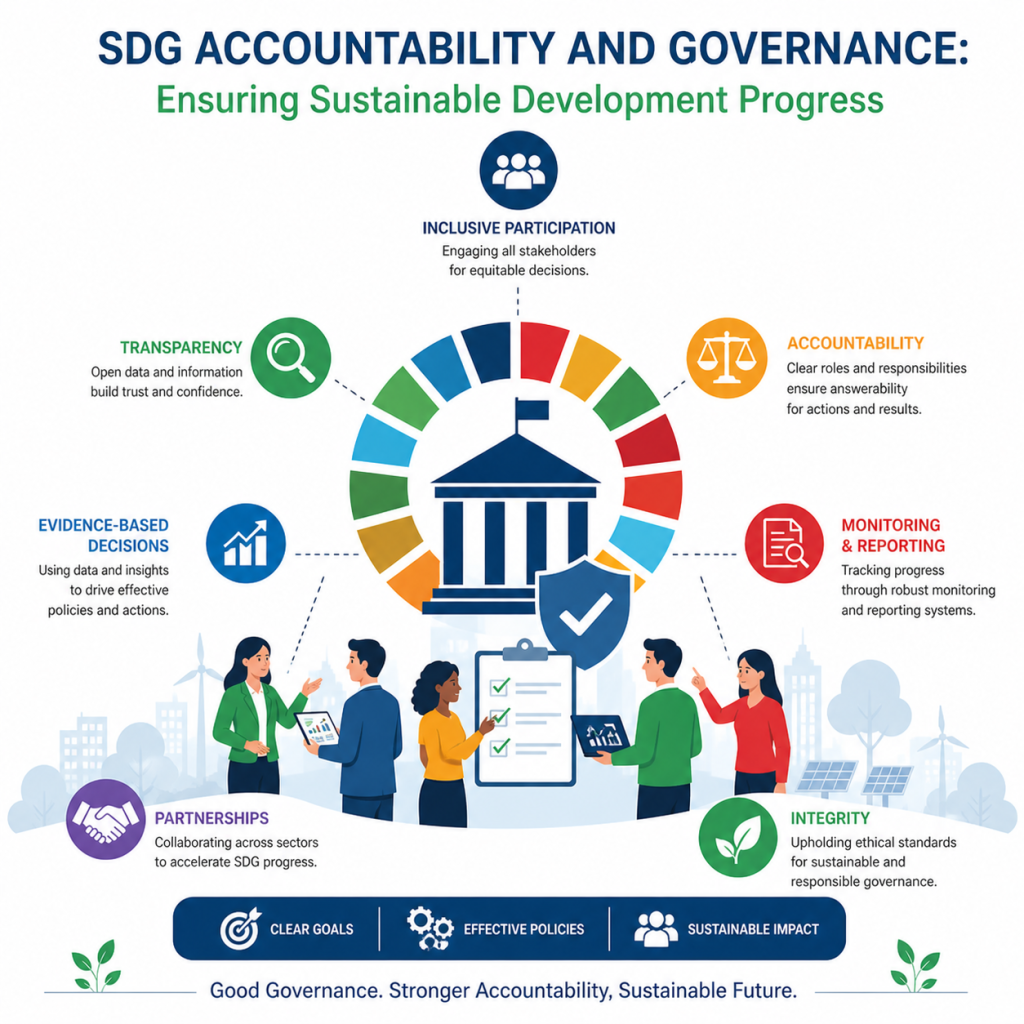
The SDG governance landscape is evolving rapidly. As the 2030 deadline approaches, the urgency to modernize accountability systems has intensified.
Digital reporting systems are already transforming how SDG data is collected, processed, and disclosed. Real-time dashboards, machine-readable reporting formats, and integrated data platforms reduce reporting burdens while improving data quality. The Intersection of Sustainability and Digital Transformation outlines how digital tools are reshaping the sustainability reporting landscape.
Data-driven governance — powered by AI, satellite imagery, and big data analytics — enables governments and institutions to monitor SDG indicators with unprecedented precision. For instance, satellite data now tracks deforestation in near real-time, making it far harder for governments to obscure forest loss. AI-driven analysis can identify patterns in socioeconomic data that manual review would miss entirely.
Strengthening global accountability requires moving beyond voluntary frameworks toward more structured oversight. Proposals include a Global Sustainability Council with peer review authority, binding corporate disclosure standards enforced across jurisdictions, and independent international auditing of national SDG reports.
Ultimately, the future of SDG accountability lies in integration — embedding sustainability governance into the same systems that govern finance, trade, and diplomacy. SDG progress cannot remain a parallel reporting exercise; it must become a core measure of national and institutional performance.
Conclusion
SDG accountability and governance are not administrative formalities — they are the mechanisms through which the world’s most ambitious development agenda either succeeds or stalls. Governments must move beyond aspirational reporting to build credible, data-driven national accountability systems. Corporations must embed SDG commitments into governance structures, not just sustainability communications. And global institutions must create stronger, more enforceable frameworks that match the scale of the challenge.
The good news is that the tools exist. Digital platforms, AI-driven monitoring, international standards, and multi-stakeholder governance models are all advancing rapidly. What remains is the collective will to use them — and the institutional courage to hold one another accountable when commitments fall short.
As 2030 approaches, the question is no longer whether SDG accountability matters. The question is whether we will build the governance architecture to make it real.
Explore more on sustainable development and corporate transparency at blog.fherist.com.