
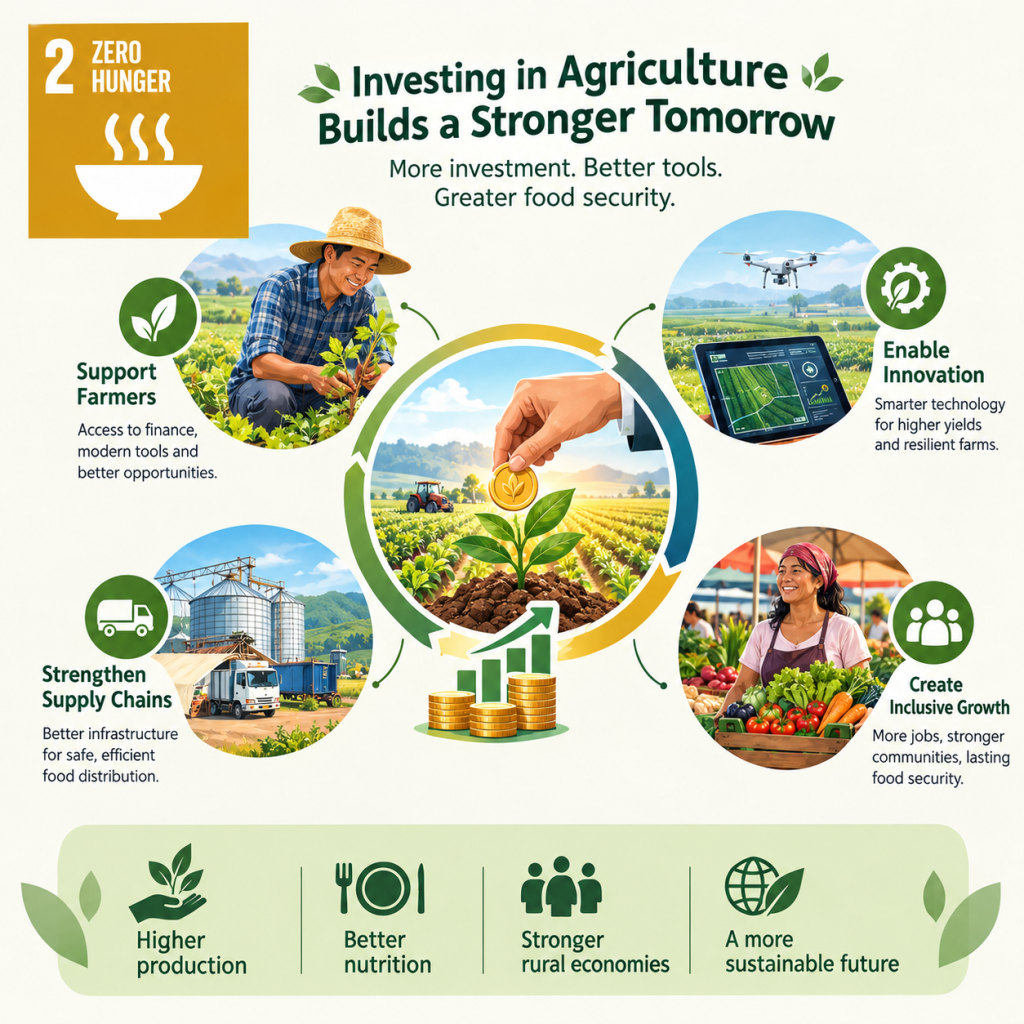
Food security does not happen by accident. It requires sustained funding directed toward farms, infrastructure, and the people who grow our food. Agricultural investment matters for SDG 2 because it provides the financial foundation that turns good intentions into real progress toward ending hunger.
The link between investment, food security, and sustainable farming runs deeper than most people realize. Without adequate capital, farmers cannot access better seeds, irrigation systems, or storage facilities. Consequently, production stagnates, food access remains limited, and communities stay vulnerable to shocks. Therefore, directing meaningful investment toward agriculture has become one of the most practical ways to accelerate progress on SDG 2.
This article explores what agricultural investment actually involves, how it supports food security goals, and where funding needs to flow to build a more resilient food future.
What Is Agricultural Investment
Agricultural investment refers to capital directed toward improving farming systems, from individual farms to entire food supply chains. This investment comes from two main sources. Public investment includes government spending on subsidies, research, and rural infrastructure, while private investment involves businesses, banks, and individual investors funding farms, agribusinesses, and related services.
Investment in farms, infrastructure, technology, and services covers a wide range of activities. On the farm level, this might mean funding better seeds or irrigation equipment. At the infrastructure level, investment often targets roads, storage facilities, and cold chain systems that move food efficiently from field to market. Meanwhile, technology investment funds tools like precision farming equipment and digital platforms, and service investment supports training, insurance, and financial products designed specifically for agricultural communities. Together, these funding streams determine how quickly and effectively food systems can develop.
How Agricultural Investment Supports SDG 2
Agricultural investment directly advances the targets outlined in SDG 2 through several interconnected pathways.
First, investment increases food production by giving farmers access to better inputs, equipment, and land management practices. When farmers can afford quality seeds and proper irrigation, yields improve significantly compared to underfunded operations working with limited resources.
Additionally, investment improves food access by funding the infrastructure needed to move food from production areas to consumers. Roads, storage facilities, and distribution networks all require capital, and without them, even strong harvests fail to reach the people who need them most.
Furthermore, investment strengthens agricultural resilience by helping farming systems withstand shocks like drought, pests, or market volatility. Capital directed toward irrigation systems, crop insurance, and diversified farming reduces the risk that a single bad season devastates an entire community’s food supply.
Investing in Smallholder Farmers
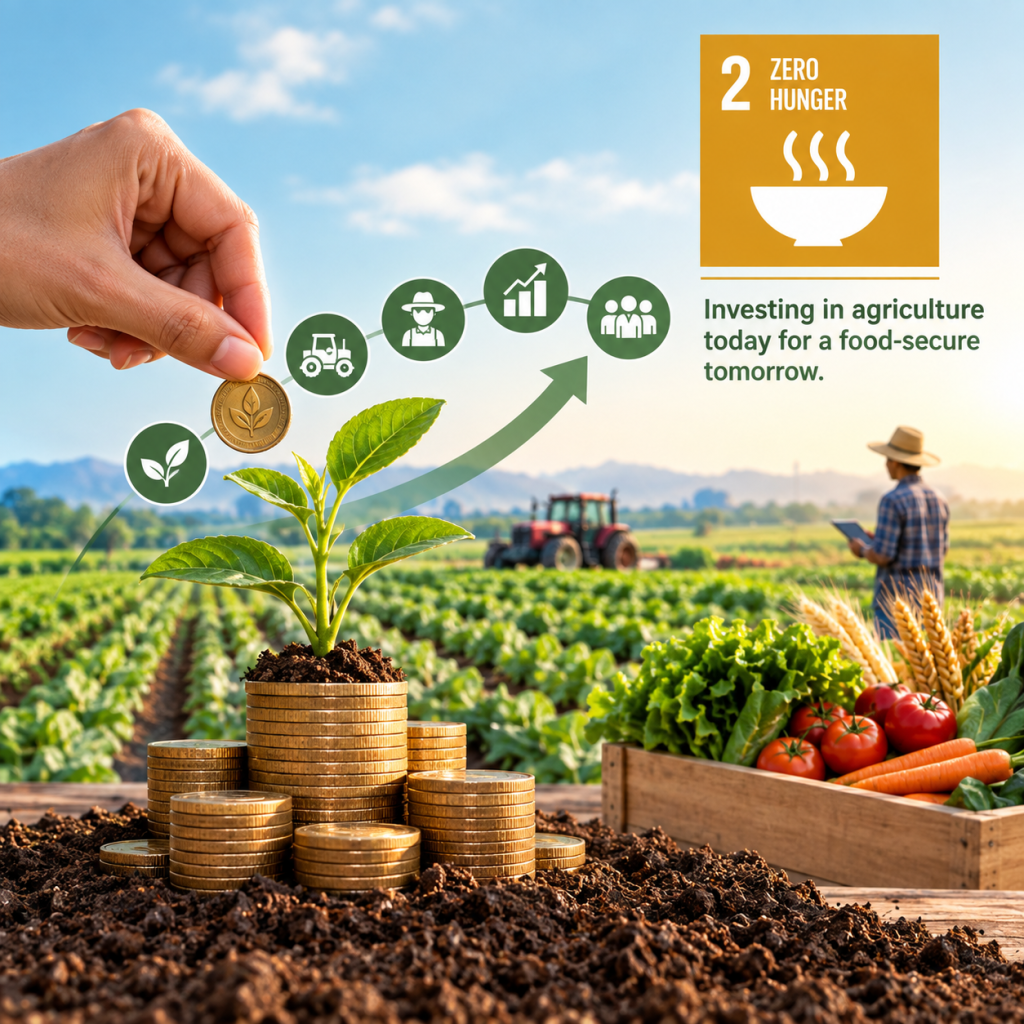
Smallholder farmers produce a significant share of the world’s food, yet they often receive the smallest share of agricultural investment.
Access to finance remains one of the biggest gaps these farmers face. Many smallholder farmers cannot secure loans from traditional banks due to lack of collateral, which forces them to rely on informal lenders charging high interest rates. Targeted microfinance programs and agricultural credit initiatives help close this gap by offering financing structured around farming income cycles rather than conventional loan terms.
Better tools and inputs follow naturally when farmers gain access to appropriate financing. Investment allows smallholder farmers to purchase quality seeds, fertilizer, and basic equipment that significantly improve productivity compared to relying on outdated methods due to financial constraints.
Improving farmer productivity and livelihoods represents the ultimate goal of this targeted investment. When smallholder farmers gain financial support alongside training, they often see measurable increases in both yield and income, which strengthens household stability and reduces vulnerability to poverty.
Investment in Sustainable Agriculture
Directing capital toward sustainable practices ensures that increased production does not come at the expense of long term environmental health.
Soil and water management investment funds practices like drip irrigation and soil testing services that help farmers use resources more efficiently. Since these systems often require upfront capital that individual farmers cannot easily afford, external investment plays a crucial role in enabling adoption.
Climate smart farming also depends heavily on investment, particularly for developing and distributing drought resistant seed varieties or funding weather forecasting tools accessible to smallholder farmers. Meanwhile, sustainable resource use more broadly benefits from investment in research and extension services that teach farmers how to maintain soil fertility without depleting it over successive growing seasons.
Technology and Agricultural Investment
Technology investment is reshaping how farmers operate and make decisions.
Digital farming tools, including mobile applications for weather forecasting and market pricing, require significant upfront development investment before reaching farmers at low or no cost. Precision agriculture technologies, such as soil sensors and satellite monitoring systems, similarly depend on sustained investment to become affordable enough for widespread adoption beyond large commercial operations.
Data driven decision making ties these technologies together, since investment in data infrastructure allows farmers to access real time insights that improve planting, irrigation, and harvesting decisions. As investment continues flowing into agricultural technology, these tools become increasingly accessible to smaller farms that previously could not afford them.
The Role of Businesses in Agricultural Investment
Businesses hold significant influence over how agricultural investment gets directed and utilized.
Responsible investment means companies prioritize funding decisions that genuinely support farmer welfare and environmental sustainability rather than purely maximizing short term returns. Sustainable sourcing partnerships further strengthen this approach, as businesses that invest directly in their supplier farms create mutual benefit, improving both product quality and farmer income simultaneously.
Supporting agricultural innovation rounds out business contributions, since companies that fund research and development for new farming technologies help accelerate solutions that benefit the entire agricultural sector, not just their own supply chains.
Challenges to Agricultural Investment
Despite clear benefits, several obstacles continue limiting the flow of investment into agriculture.
- Financial risks discourage many investors, since agriculture faces unpredictable variables like weather and pest outbreaks that can quickly erode expected returns
- Limited infrastructure in many regions makes it difficult for investment to translate into actual productivity gains, since farmers still lack roads or storage to capitalize on improvements
- Climate and market uncertainty compound these risks further, as unpredictable growing conditions and volatile commodity prices make long term agricultural investment planning genuinely difficult
These overlapping challenges explain why agriculture historically receives less investment relative to its economic importance, particularly in developing regions where the need remains greatest.
Benefits of Strong Agricultural Investment
When investment flows consistently into agriculture, the benefits extend across the entire food system.
More resilient food systems emerge as diversified funding builds capacity to withstand disruptions that would otherwise devastate underfunded farming operations. Better farmer incomes follow as investment improves productivity and market access, allowing farmers to earn more from the same land and labor.
Progress toward Zero Hunger ultimately results from these combined improvements, since well funded food systems produce more, distribute more efficiently, and support the farmers responsible for feeding communities worldwide.
Conclusion
Agricultural investment is essential for advancing SDG 2 and reducing hunger, since food security ultimately depends on capital reaching the farms and systems that produce our food. Investment can improve food production, farmer livelihoods, infrastructure, and access to sustainable technologies simultaneously, creating benefits that compound over time.
Supporting smallholder farmers and sustainable agricultural practices can make food systems more resilient against the shocks that increasingly threaten global food supply. Governments, businesses, investors, and communities all have a role in directing investment toward long term food security rather than short term gains. Strong and responsible agricultural investment can help create more productive, inclusive, and sustainable food systems while moving the world closer to Zero Hunger.