
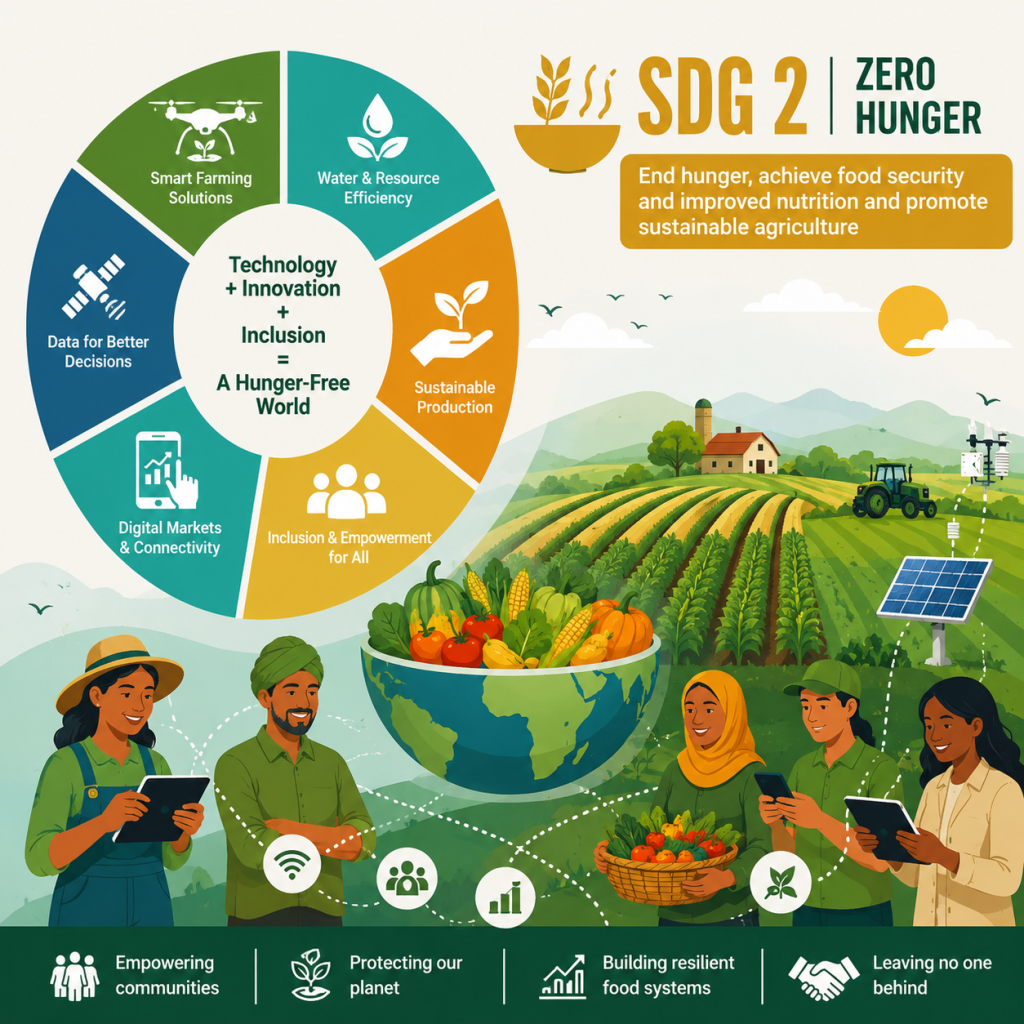
Farming has changed dramatically over the past few decades. What once relied entirely on intuition and manual labor now increasingly depends on sensors, data, and software. Agricultural technology sits at the heart of this transformation, and it plays a direct role in advancing Sustainable Development Goal 2, which aims to end hunger and improve food security worldwide.
Technology matters for improving food production because traditional methods alone cannot keep pace with rising global demand. As populations grow and climate conditions shift, farmers need smarter tools to produce more food using fewer resources. Therefore, agricultural technology has become essential rather than optional for achieving lasting food security.
This article explores what agricultural technology actually involves, how it supports SDG 2, and where innovation is heading next.
What Is Agricultural Technology
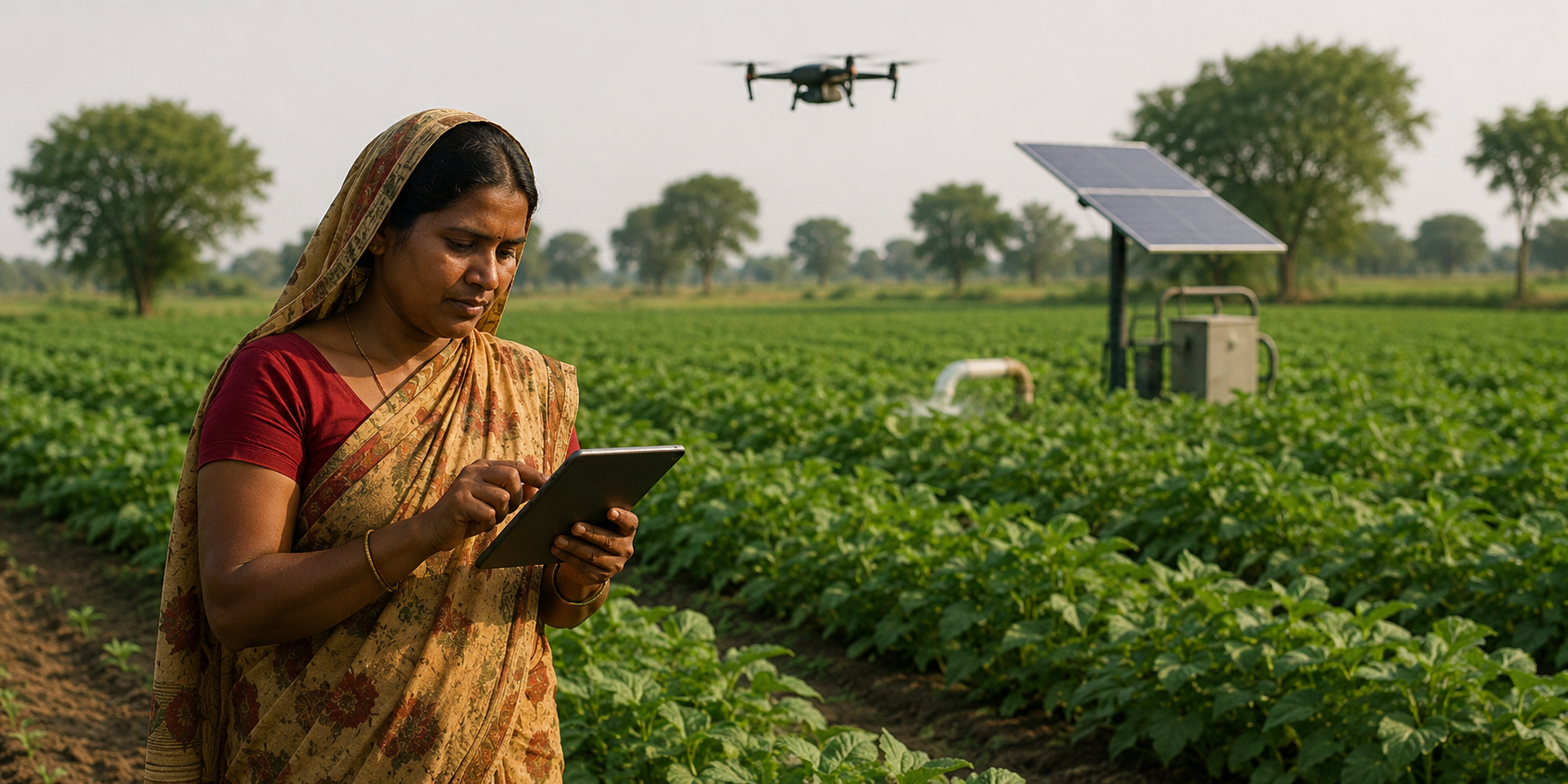
Agricultural technology refers to the tools, systems, and digital solutions farmers use to improve how they grow, monitor, and manage crops and livestock. Modern technologies used in farming include soil sensors, satellite imagery, automated machinery, mobile applications, and data analytics platforms that help farmers make more informed decisions throughout the growing season.
The evolution from traditional to data driven agriculture has happened gradually but significantly. Farmers once relied almost entirely on experience, seasonal patterns, and visual inspection to guide their decisions. While that knowledge remains valuable, it now works alongside precise data on soil moisture, weather forecasts, and crop health. Consequently, farming has shifted from a largely intuitive practice toward one increasingly guided by measurable, real time information. This shift allows farmers to respond to problems faster and make decisions based on evidence rather than guesswork alone.
How Technology Can Support SDG 2
Agricultural technology directly advances the goals outlined in SDG 2 in several meaningful ways.
First, technology improves agricultural productivity by helping farmers grow more food on the same amount of land. Tools like yield mapping and soil analysis allow farmers to identify exactly where crops are underperforming, then address those specific problems rather than guessing across an entire field.
Additionally, technology supports reliable food production by reducing the uncertainty that has traditionally made farming so risky. Weather forecasting tools and early pest detection systems help farmers prepare for problems before they cause serious damage, which stabilizes production even during difficult seasons.
Furthermore, technology helps farmers make better use of land and resources, ensuring water, fertilizer, and energy get applied efficiently rather than wastefully. As a result, farms can increase output while reducing the environmental strain that often comes with expanding agricultural production.
Precision Agriculture
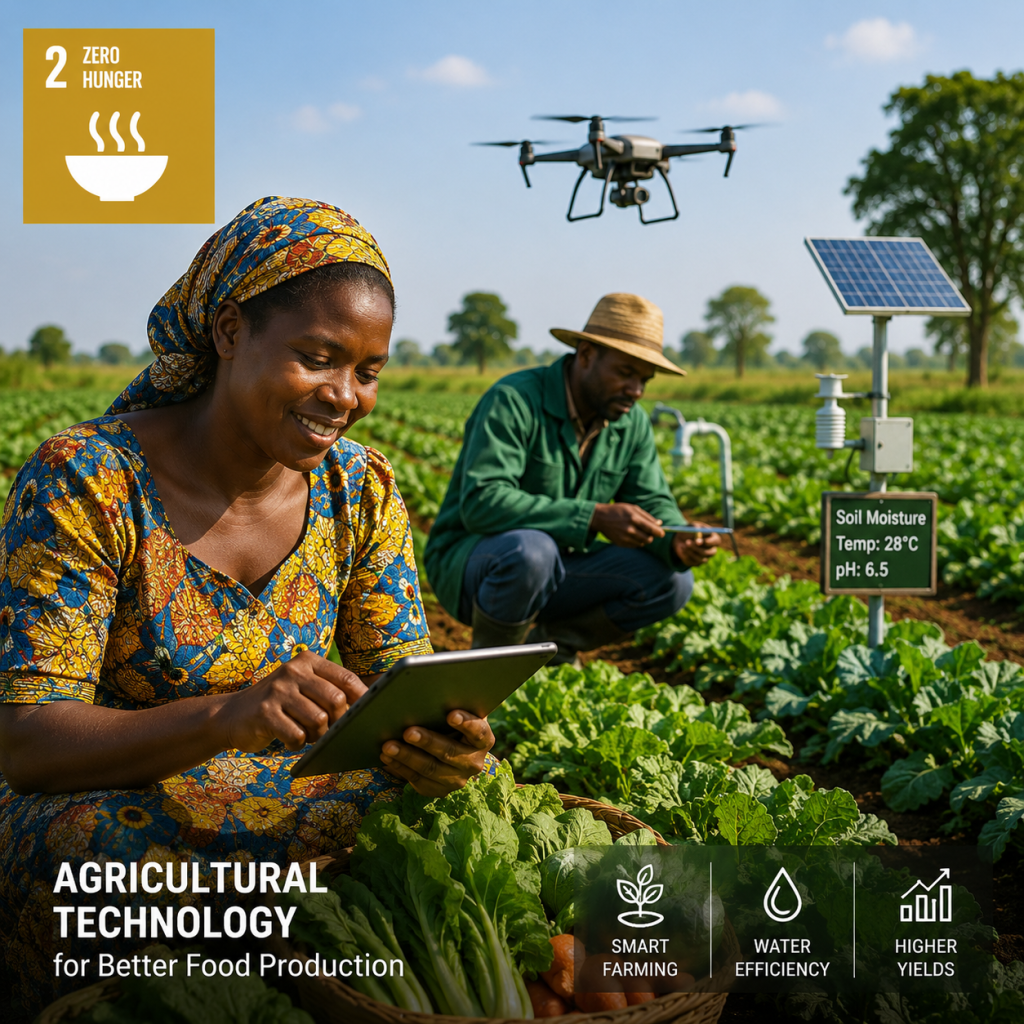
Precision agriculture represents one of the most impactful applications of modern farming technology. Sensors and field monitoring systems collect real time data on soil conditions, moisture levels, and plant health across every section of a farm. This granular visibility allows farmers to identify problems in specific areas rather than treating an entire field the same way regardless of actual need.
Data based crop management builds on this foundation by helping farmers decide exactly when to plant, fertilize, or harvest based on measurable conditions rather than fixed schedules. Meanwhile, targeted use of water and inputs ensures that resources go exactly where they are needed most. For example, instead of irrigating an entire field uniformly, precision systems can direct extra water only to sections showing signs of dryness, while reducing water in areas that already have sufficient moisture. This targeted approach significantly reduces waste while maintaining or even improving overall yields.
AI and Data in Agriculture
Artificial intelligence is increasingly shaping how farmers approach daily decision making. Weather and crop predictions powered by AI analyze historical patterns alongside current conditions to forecast outcomes with growing accuracy. This helps farmers plan planting and harvesting schedules with greater confidence.
Identifying crop health issues has also become faster and more accurate through AI powered image recognition. Farmers can photograph a plant showing unusual symptoms, and AI systems can often identify diseases or nutrient deficiencies within seconds, long before the problem becomes visible to the naked eye across a wider area.
Supporting better farming decisions ultimately ties these capabilities together. Rather than replacing farmer expertise, AI tools provide additional information that helps farmers act faster and with greater precision. As a result, decisions that once relied purely on experience now benefit from data driven confirmation as well.
Smart Irrigation and Resource Management
Water remains one of agriculture’s most critical and increasingly limited resources. Efficient water use has become a top priority as many regions face growing water scarcity. Smart irrigation systems address this directly by monitoring soil moisture continuously and adjusting water delivery based on actual plant needs rather than fixed schedules.
Automated irrigation takes this a step further by removing the need for manual adjustment entirely. These systems can respond to changing weather conditions automatically, reducing water during rainfall and increasing it during dry spells without requiring constant farmer oversight.
Reducing resource pressure extends beyond water alone. Smart resource management systems also help optimize fertilizer and energy use, ensuring farms operate more efficiently overall. Consequently, farms adopting these systems often see meaningful cost savings alongside their environmental benefits.
Digital Tools for Farmers
Beyond field level technology, digital platforms are transforming how farmers access information and connect with markets.
- Mobile agricultural platforms provide farmers with real time weather updates, pest alerts, and farming guidance directly on their smartphones
- Digital marketplaces connect farmers directly with buyers, reducing dependence on intermediaries who often reduce farmer profit margins
- Access to farming information and services has expanded significantly, giving farmers in remote areas resources that were previously available only to those near agricultural extension offices
For instance, a farming cooperative in rural India recently adopted a mobile platform that combined weather alerts with a direct marketplace connection. Within one growing season, member farmers reported both fewer weather related losses and noticeably better prices, since they could sell directly to buyers rather than relying solely on local traders. This case demonstrates how digital tools can address multiple challenges simultaneously through a single accessible platform.
Benefits of Agricultural Technology
Agricultural technology delivers benefits that extend across productivity, sustainability, and farmer decision making.
Higher productivity results from more precise management of crops and resources, allowing farms to produce more without necessarily expanding land use. Resource efficiency follows closely behind, since targeted application of water and inputs reduces waste significantly compared to traditional blanket approaches.
Improved resilience also emerges as farms equipped with predictive tools can prepare for and respond to disruptions faster than those relying solely on traditional methods. Finally, better decision making ties everything together, as farmers gain access to real time data that supports faster, more informed choices throughout the growing season.
Challenges to Technology Adoption
Despite clear benefits, several obstacles continue to slow widespread adoption of agricultural technology.
Cost of technology remains a significant barrier, particularly for smallholder farmers who often cannot afford advanced sensors or automated equipment upfront. Meanwhile, digital skills gaps prevent some farmers from fully utilizing available tools, even when they can access them.
Infrastructure limitations, including unreliable internet access and inconsistent electricity, further restrict technology adoption in many rural regions. Additionally, unequal access means that larger commercial farms often benefit from these innovations far sooner than smaller operations, creating a growing gap between well resourced and under resourced farmers.
The Future of Agricultural Technology
Looking ahead, AI powered farming will likely become increasingly sophisticated, offering more accurate predictions and automated recommendations tailored to specific farms rather than general conditions.
Automation and robotics are also advancing quickly, with machines increasingly capable of handling tasks like planting, weeding, and harvesting that once required significant manual labor. Meanwhile, connected farms, where multiple devices and systems share data seamlessly, will likely become more common as infrastructure improves.
Ultimately, these advances point toward data driven food systems where decisions across entire supply chains, not just individual farms, become guided by real time information and predictive analytics.
Conclusion
Agricultural technology plays a genuinely transformative role in advancing SDG 2 by helping farmers produce more food more efficiently, even amid growing environmental pressures. From precision agriculture to AI powered insights, these tools address real production challenges rather than offering abstract solutions.
However, making innovation accessible and sustainable matters just as much as developing it in the first place. As costs decline and infrastructure improves, agricultural technology has the potential to support farmers of every size, building a more productive and food secure future for everyone.