

Good health is more than the absence of physical illness. That idea sits at the heart of Mental Health and SDG 3, the global promise to ensure healthy lives and promote wellbeing for all.
The scale of need is hard to ignore. The World Health Organization (WHO) reports that more than 1 billion people live with a mental health condition [1]. Anxiety and depression are the most common. Together, they are the second biggest cause of long term disability worldwide [1].
Physical health outcomes alone cannot show whether a society is thriving. Mental health and wellbeing shape how people learn, work, build relationships, and take part in community life. Consequently, they also influence education, employment, social participation, and economic resilience.
That is why mental health has become a major public health and sustainable development issue. WHO released its latest global data ahead of the 2025 UN High Level Meeting on noncommunicable diseases and the promotion of mental health and wellbeing [1].
SDG target 3.4 reflects this shift. By 2030, it calls for reducing premature deaths from noncommunicable diseases through prevention and treatment, and for promoting mental health and wellbeing [2]. Indicator 3.4.2 tracks the suicide mortality rate [2].
This guide looks at what the evidence shows and where the gaps remain. It also explains what governments, health systems, and employers can do. For wider context, see our overview of SDG 3: Good Health and Well being.
Mental Health and Sustainable Development
Mental health supports many parts of sustainable development, not just health goals. When people are well, they can learn, earn, care for others, and contribute to their communities.
Here is how mental health connects to key development outcomes:
- Education: Learners who feel well can concentrate, attend regularly, and build skills for later life.
- Employment: Good mental health helps people find work, keep it, and perform safely.
- Workforce participation: Untreated conditions can push people out of work or keep them from entering it.
- Social inclusion: Stigma isolates people, while supportive services help them stay connected.
- Quality of life: Wellbeing shapes daily functioning, relationships, and a sense of purpose.
- Community resilience: Communities with strong mental health support can cope better with shocks such as conflict, disasters, and economic stress.
Mental health is also a population health issue, not only an individual one. WHO notes that anxiety and depression affect people of all ages and income levels in every country [1]. Because risks come from living and working conditions, solutions must reach beyond the clinic. They need to include schools, workplaces, and community systems.
This is why mental health sits inside SDG 3 rather than beside it. Progress on target 3.4 depends on prevention and care working together. Our post on preventive healthcare and SDG 3 explores that link in more depth.
The Global Mental Health Gap
A treatment gap is the difference between people who need support and people who receive it. For mental health access, that gap is wide.
WHO’s 2025 data show the problem clearly [1]:
- Spending is low. Median government spending on mental health has stayed at about 2% of health budgets since 2017.
- Spending is unequal. High income countries spend up to US$65 per person. Low income countries spend as little as US$0.04.
- Workers are scarce. The global median is 13 mental health workers per 100,000 people.
- Community care is rare. Fewer than 10% of countries have fully moved to community based care.
- Coverage varies sharply. For psychosis, fewer than 10% of affected people in low income countries receive care. In higher income nations, the figure is above 50%.
Several barriers explain these numbers:
- Lack of professionals. Few trained workers means long waits or no care at all.
- Cost of treatment. Fees and travel costs can put care out of reach.
- Stigma. Fear of judgement stops many people from seeking help.
- Geographic inequality. Services cluster in cities and leave rural areas behind.
- Limited healthcare infrastructure. Many systems lack clinics, medicines, and referral pathways.
- Lack of early intervention. Problems often go unnoticed until they become severe.
Low and middle income countries face the sharpest challenges. They have fewer workers, smaller budgets, and weaker service networks. Moreover, the International Association for Suicide Prevention reports that 73% of suicide deaths in 2021 occurred in low and middle income countries [3].
Untreated conditions carry costs for everyone. Individuals lose health and income. Families absorb care duties and expenses. Communities lose skills and participation. Economies lose productivity, since WHO finds that indirect costs far exceed direct health care costs [1].
Mental Health and the Workplace
Mental health matters to employers because work fills so much of adult life. WHO estimates that 16% of working age adults had a mental disorder in 2023 [4].
The business impact is large. Globally, depression and anxiety cause an estimated 12 billion lost working days each year. That costs US$1 trillion in lost productivity [4].
Poor workplace mental health shows up in several measurable ways:
- Absenteeism: Employees miss work because of illness or distress.
- Presenteeism: Employees attend work but cannot perform at full capacity.
- Employee retention: People leave jobs that harm their wellbeing, which raises hiring costs.
- Productivity: Concentration, decision making, and teamwork can suffer.
- Workforce participation: Untreated conditions can keep people out of the labour market.
- Workplace safety: Reduced focus and fatigue can raise risk in safety critical roles.
These costs are both human and economic. People suffer first. Organisations then lose skills, output, and stability.
Importantly, work can also create the risks. WHO lists discrimination and inequality, excessive workloads, low job control, and job insecurity as threats to mental health [4]. Poor work life balance and weak organisational support can add to the strain.
Therefore, employers cannot treat mental health as a purely personal matter. WHO and the International Labour Organization (ILO) have jointly called for concrete action on mental health at work [5]. WHO’s guidelines set out evidence based recommendations to promote mental health and prevent conditions [4]. Our article on employee wellbeing and corporate sustainability shows how this fits into ESG strategy.
Prevention and Early Intervention
Early support matters because many conditions begin mild. The OECD reports that mild to moderate depressive symptoms affect one in five adults across OECD and EU27 countries. They often go unrecognised and untreated, which raises the risk of progression to more severe conditions [6].
Strong mental health prevention relies on six system level approaches:
- Community based services: Local teams provide care close to where people live.
- School based programmes: Schools can build resilience and spot problems in young people.
- Workplace mental health programmes: Employers can reduce risks and connect staff to care.
- Early identification: Trained front line professionals can recognise warning signs sooner. The OECD lists mental health literacy training for this group as a promising practice [6].
- Primary care integration: Family doctors and nurses can treat common conditions without specialist referral.
- Public awareness programmes: Campaigns reduce stigma and encourage people to seek help.
Progress is uneven. WHO reports that most countries now run functional promotion initiatives, such as early childhood development, school based programmes, and suicide prevention [1]. In addition, 71% of countries meet at least three of five WHO criteria for integrating mental health into primary care [1]. Yet fewer than 10% have fully shifted to community based care [1].
Early support can lower severity. OECD analyses find that promising interventions improve mental wellbeing and prevent symptom deterioration [6]. As a result, people face fewer long term consequences, and health systems and workplaces carry lighter burdens.
Digital Mental Healthcare
Digital tools are changing how people reach support. They can widen access where clinics, specialists, or time are in short supply.
Key tools include:
- Teletherapy: Therapy sessions delivered by video or phone.
- Digital mental health platforms: Structured programmes, often supported by trained helpers.
- Remote consultations: Visits with doctors or counsellors without travel.
- Mobile health applications: Self help tools, symptom tracking, and reminders.
- AI assisted screening or risk identification: Software that flags possible symptoms for clinicians to review.
- Digital monitoring: Tracking sleep, activity, or mood patterns to spot early warning signs.
For people facing distance, cost, or workforce shortages, these tools can lower barriers. WHO’s 2024 Mental Health Atlas notes that outpatient services and telehealth are becoming more available, although access remains uneven [1].
A real world example: WHO Step by Step. Step by Step is a guided digital programme for depression, delivered with support from non specialist helpers. A randomised trial among 569 displaced Syrians in Lebanon was published in PLOS Medicine in 2022. After treatment, average depression scores were 10.8 in the programme group and 13.6 in the comparison group. Both groups started at about 16.4 [7].
Lower scores mean fewer symptoms. However, the trial’s main limitation was a high dropout rate [7]. A 2024 PLOS Medicine trial of a self guided version for Syrian refugees in Egypt found only small positive effects [8]. Together, these results suggest that human guidance matters.
Digital mental healthcare also has limits:
- Data privacy: Mental health data is highly sensitive and needs strong protection.
- Digital inequality: People with the greatest need may have the least access.
- Internet access: Poor connectivity limits reach in rural and low income settings.
- Accuracy of AI systems: Screening tools can miss cases or raise false alarms.
- Lack of human oversight: Automated advice should never replace clinical judgement, especially in a crisis.
- Digital literacy: Some people need training or helpers to use tools well.
The Economic Case for Mental Health
Mental health is also an economic issue. Untreated or poorly managed conditions reduce income and output while raising costs.
The main cost channels are:
- Lost productivity: Reduced output from people who work while unwell or cannot work.
- Absenteeism: Missed workdays across industries.
- Presenteeism: Lower performance while at work.
- Reduced workforce participation: People leaving paid work or never entering it.
- Healthcare costs: Spending on services, medicines, and related conditions.
- Long term disability: WHO ranks mental disorders as the second biggest cause of long term disability [1].
The totals are large. WHO estimates that depression and anxiety alone cost the global economy about US$1 trillion each year. It adds that indirect costs, such as lost productivity, are far greater than health care costs [1].
The case for investment is also documented. A WHO led study in The Lancet Psychiatry modelled 36 countries in 2016. It found that every US$1 invested in scaling up treatment for depression and anxiety returns US$4 in better health and ability to work [9].
The same study put the cost of scale up at US$147 billion from 2016 to 2030. A 5% improvement in labour force participation and productivity was valued at US$399 billion. Improved health added another US$310 billion [9].
Some caution is needed. This is a modelled estimate from 2016, and it covers treatment for depression and anxiety. It does not guarantee the return on any single employer programme. Even so, it shows why mental healthcare works as an investment and not only as a cost.
A Case Study
Norway’s Prompt Mental Health Care
What was introduced. Prompt Mental Health Care (PMHC) is Norway’s version of England’s Improving Access to Psychological Therapies programme. Norway’s Ministry of Health and Care Services launched it as a pilot in 2012. The service is free, low threshold, and needs no referral [10].
The problem it addressed. Access to care for anxiety and depression was limited. Researchers estimated Norway’s treatment gap for these conditions at over 50% [12].
Target population. PMHC serves people aged 16 and over with mild to moderate mental health needs [6].
How it was implemented. Teams operate in municipalities and city districts. The OECD reports 75 teams across 88 municipalities and districts, treating about 23,500 people each year [6]. Treatment is short and evidence based, mainly cognitive behavioural therapy [12].
Measurable results:
- A randomised trial in two Norwegian sites compared PMHC with usual care. Six months after baseline, reliable recovery was 58.5% with PMHC and 31.9% with usual care [11].
- The OECD describes this as an 83% increase in recovery and reports gains sustained at 12, 24, and 36 months [6].
- A real world study of 2,512 clients treated between 2014 and 2016 found reliable recovery of 58% using multiple imputation. A more conservative method gave 48% [12].
- OECD modelling estimates a cumulative gain of about 46,000 disability adjusted life years for Norway by 2050 if PMHC expands [6].
Limitations and criticisms:
- Younger people and those in deprived areas were less likely to recover or complete treatment. Clients aged 16 to 17 had the lowest odds of recovery [12].
- The trial found no statistically significant effect on work participation [11].
- The OECD notes that non inferiority to standard therapy could not be confirmed, although both approaches produced recovery rates above 50% [6].
- Annual monitoring reports cited in early evaluations averaged recovery rates of 46% to 49%, lower than the trial figure [12].
- PMHC targets mild to moderate conditions, so it does not replace care for severe illness.
Why it matters. Norway shows that a primary care model can expand access and deliver measurable recovery. However, it also shows that equity gaps persist even in a wealthy, universal system.
Measuring Mental Health and SDG 3 Progress
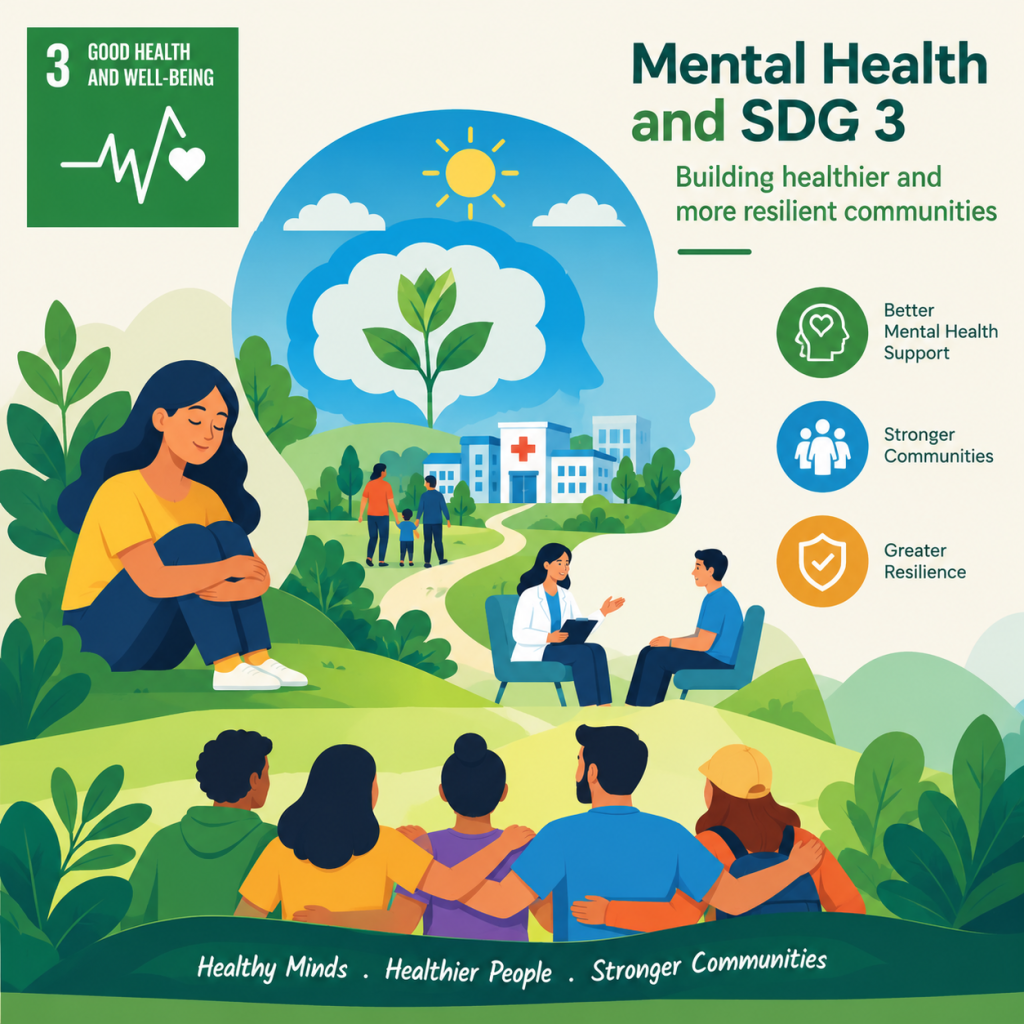
Mental health enters SDG monitoring through target 3.4. Indicator 3.4.2, the suicide mortality rate, is the formal measure [2]. WHO adds service indicators on access, treatment coverage, financing, and workforce.
Key indicators to watch:
- SDG 3.4.2: Suicide mortality rate.
- Mental health service access: Whether people can reach services.
- Treatment coverage: The share of people with a condition who receive care.
- Related WHO indicators: Spending, workforce numbers, and the shift to community based care [1].
What do the numbers show?
- Scale: About 727,000 people died by suicide in 2021 [1].
- Global rate: The age standardised rate was 8.9 per 100,000, which is 35% lower than in 2000 [13].
- Pace: WHO says progress is too slow to meet the global goal of a one third reduction by 2030. On the current trajectory, only a 12% reduction will be achieved [1].
- Sex gap: The male rate was 12.3 per 100,000, against 5.6 for females [13].
- Income gap: High income countries had the highest rate, at 11.8 per 100,000 [13]. Yet most deaths occur in low and middle income countries [3].
- Regional gap: In South East Asia, the female rate was 8.3, well above the global female rate [13].
- Country gap: Within the Americas, 2021 rates ranged from 26.4 per 100,000 in Guyana to 0.3 in Saint Vincent and the Grenadines [14].
A falling global rate shows that progress is possible. However, wide gaps between groups and places show that averages hide who is left behind. The UN also reports that the wider target on premature noncommunicable disease deaths is not on track [2].
Suicide mortality alone cannot capture the state of global mental health:
- It measures only the most severe outcome.
- It misses the more than 1 billion people living with conditions such as anxiety and depression [1].
- It says little about whether people can reach care.
- It cannot show disability, lost work, or reduced quality of life.
- Data gaps remain. Only 22 countries supplied enough data to estimate service coverage for psychosis [1].
Therefore, countries need service and coverage indicators alongside mortality data.
What Businesses Can Do
Businesses cannot replace public healthcare systems. They can, however, reduce harm at work and connect people to care. WHO’s guidelines focus on promoting mental health, preventing conditions, and helping people thrive at work [4].
Practical workplace mental health actions include:
- Employee assistance programmes: Confidential counselling and referral services.
- Mental health benefits: Insurance cover that includes therapy and psychiatric care.
- Psychosocial risk management: Regular assessment of workload, job control, and job security, with action on the findings.
- Manager training: Teaching leaders to spot warning signs and respond with support.
- Flexible workplace policies: Schedules and leave that help people manage health and caring duties.
- Safe reporting mechanisms: Channels to report bullying, harassment, or unsafe workloads without fear.
- Workplace mental health education: Training that builds understanding and reduces stigma.
- Access to professional support: Clear paths to clinicians, not just wellness tips.
Organisational conditions matter most. Telling employees to cope better does not fix an excessive workload or job insecurity. WHO identifies those conditions as risks in themselves [4]. Therefore, programmes should change how work is designed and managed first, and support individuals second.
These steps also support sustainable business. Fewer lost days and lower turnover strengthen workforce resilience. Companies can also track psychosocial risk indicators alongside other social metrics in sustainability reporting. Our guide to sustainable business practices covers related ideas.
Conclusion
Mental Health and SDG 3 are inseparable. The evidence shows more than 1 billion people living with mental health conditions, underfunded services, and economic losses measured in trillions of dollars [1].
Stronger mental health systems can support healthier individuals, communities, and workforces. Prevention and early intervention catch problems before they escalate. Better mental health access, in clinics and online, helps people stay well enough to learn and work. Economic participation and social resilience then follow.
The proof of what works already exists. Norway’s Prompt Mental Health Care raised recovery rates in a randomised trial [11]. WHO’s analysis estimates a US$4 return for every US$1 invested in treating depression and anxiety [9].
Yet current suicide trends point to only a 12% reduction against a goal of one third by 2030 [1]. That gap defines the task ahead for SDG 3 and sustainable development.
Governments need to fund and integrate care. Employers need to fix the conditions that harm. Health systems need to measure access and coverage, not mortality alone.
References
- World Health Organization (2 September 2025). Over a billion people living with mental health conditions, services require urgent scale up. Includes data from World Mental Health Today and the Mental Health Atlas 2024. https://www.who.int/news/item/02-09-2025-over-a-billion-people-living-with-mental-health-conditions-services-require-urgent-scale-up
- United Nations. Goal 3: Good Health and Well being, including Target 3.4 and Indicator 3.4.2. https://www.un.org/sustainabledevelopment/health/
- International Association for Suicide Prevention (2025). New WHO suicide data reaffirms urgent need for global prevention efforts. https://www.iasp.info/2025/06/02/who-suicide-data/
- World Health Organization. Mental health at work, fact sheet. https://www.who.int/news-room/fact-sheets/detail/mental-health-at-work
- WHO and ILO (28 September 2022). WHO and ILO call for new measures to tackle mental health issues at work. https://www.who.int/europe/news/item/28-09-2022-who-and-ilo-call-for-new-measures-to-tackle-mental-health-issues-at-work
- OECD (2025). Mental Health Promotion and Prevention: Prompt Mental Health Care. https://www.oecd.org/en/publications/mental-health-promotion-and-prevention_88bbe914-en/full-report/prompt-mental-health-care_9a9ca5db.html