
1. Introduction to SDG 8
The global economy plays an important role in shaping people’s lives, creating employment opportunities, reducing poverty, and supporting the development of communities. However, economic progress is not meaningful if workers face unfair wages, unsafe workplaces, discrimination, or exploitation. Sustainable development requires an economy that creates opportunities while protecting the rights and well-being of workers.
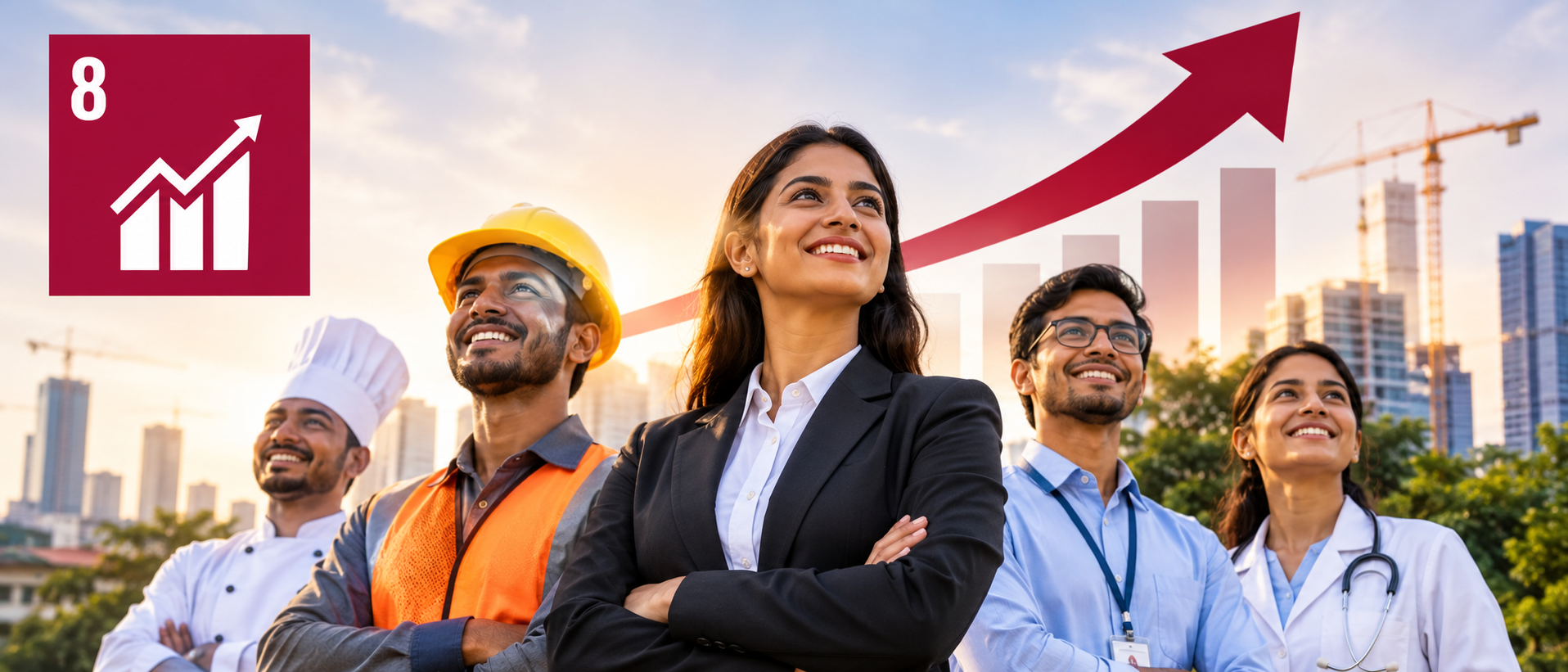
This is the purpose of Sustainable Development Goal 8 (SDG 8), which focuses on decent work and economic growth. It recognises that economic development and social progress should go hand in hand, ensuring that people can access productive employment and enjoy fair working conditions.
What Is SDG 8?
SDG 8, officially titled Decent Work and Economic Growth, is one of the 17 Sustainable Development Goals established by the United Nations (UN) in September 2015 as part of the 2030 Agenda for Sustainable Development.
Its central aim is to promote sustained, inclusive, and sustainable economic growth, full and productive employment, and decent work for everyone.
The goal recognises that economic growth should create meaningful employment opportunities, improve living standards, encourage innovation, and protect workers’ rights. It also emphasises the importance of supporting entrepreneurship, improving productivity, and eliminating practices such as forced labour and child labour.
SDG 8 therefore connects economic development with social responsibility. It encourages governments, businesses, and communities to build an economy in which people can earn a fair living, work in safe environments, and contribute to long-term prosperity. Department of Economic and Social Affairs+1
Why Does SDG 8 Matter?
Employment provides people with more than a regular income. It can improve financial security, support families, develop professional skills, and create opportunities for a better quality of life. When people have access to decent employment, they are better positioned to meet their basic needs, participate in their communities, and plan for the future.
Economic growth also supports businesses and national development. Growing businesses can invest in new technologies, expand their operations, create jobs, and contribute to public services through taxation.
However, economic growth should not be measured only by increases in national income. It should also be assessed by how fairly its benefits are distributed and whether workers and communities experience genuine improvements in their lives.
For example, a country may experience strong economic growth while many workers continue to receive inadequate wages or work without legal protection. SDG 8 addresses this imbalance by promoting economic progress that benefits workers, businesses, and society as a whole.
2. Understanding Decent Work
Decent work is one of the most important elements of SDG 8. It recognises that having a job does not automatically mean that a person enjoys fair employment conditions. The quality of employment matters just as much as the number of jobs available.
The International Labour Organization (ILO) promotes decent work as an essential foundation for social justice, economic development, and sustainable livelihoods.
What Makes a Job Decent?
Decent work refers to employment that provides people with productive opportunities, fair income, workplace security, equal treatment, and respect for their fundamental rights.
A decent job should allow workers to support themselves and their families without exposing them to exploitation or unnecessary risks.
Its main characteristics include:
- Fair wages: Employees should receive appropriate compensation for their work and be paid on time.
- Safe working conditions: Workplaces should protect employees from physical hazards, accidents, and occupational illnesses.
- Equal opportunities: People should have fair access to employment and career development regardless of gender, disability, age, or background.
- Workers’ rights: Employees should be protected against discrimination, harassment, forced labour, and unfair treatment.
- Social protection: Workers should have access to appropriate protections, such as maternity benefits, healthcare coverage, pensions, and support during unemployment.
- Employment security: Workers should benefit from clear employment arrangements and protection against arbitrary or unfair dismissal.
These conditions help create workplaces where employees feel respected, protected, and motivated. They also benefit employers through improved productivity, stronger employee relationships, and more stable operations. Department of Economic and Social Affairs+1
Decent Work vs. Unfair Employment
The difference between decent work and unfair employment is mainly determined by how workers are treated and whether their rights and well-being are protected.
Decent employment provides fair compensation, reasonable working hours, appropriate safety measures, and opportunities for professional development. Unfair employment, on the other hand, may involve exploitation, inadequate wages, unsafe conditions, excessive working hours, or discrimination.
For example, consider two workers employed in clothing factories. The first works under a formal contract, receives a fair salary, has access to protective equipment, and can report workplace concerns without fear of punishment. The second works excessive hours, receives wages below legal requirements, and has no protection against workplace accidents.
Although both individuals have jobs, only the first worker benefits from conditions that reflect the principles of decent work.
This distinction is important because SDG 8 aims not simply to increase employment figures but to ensure that employment opportunities are fair, productive, and sustainable.
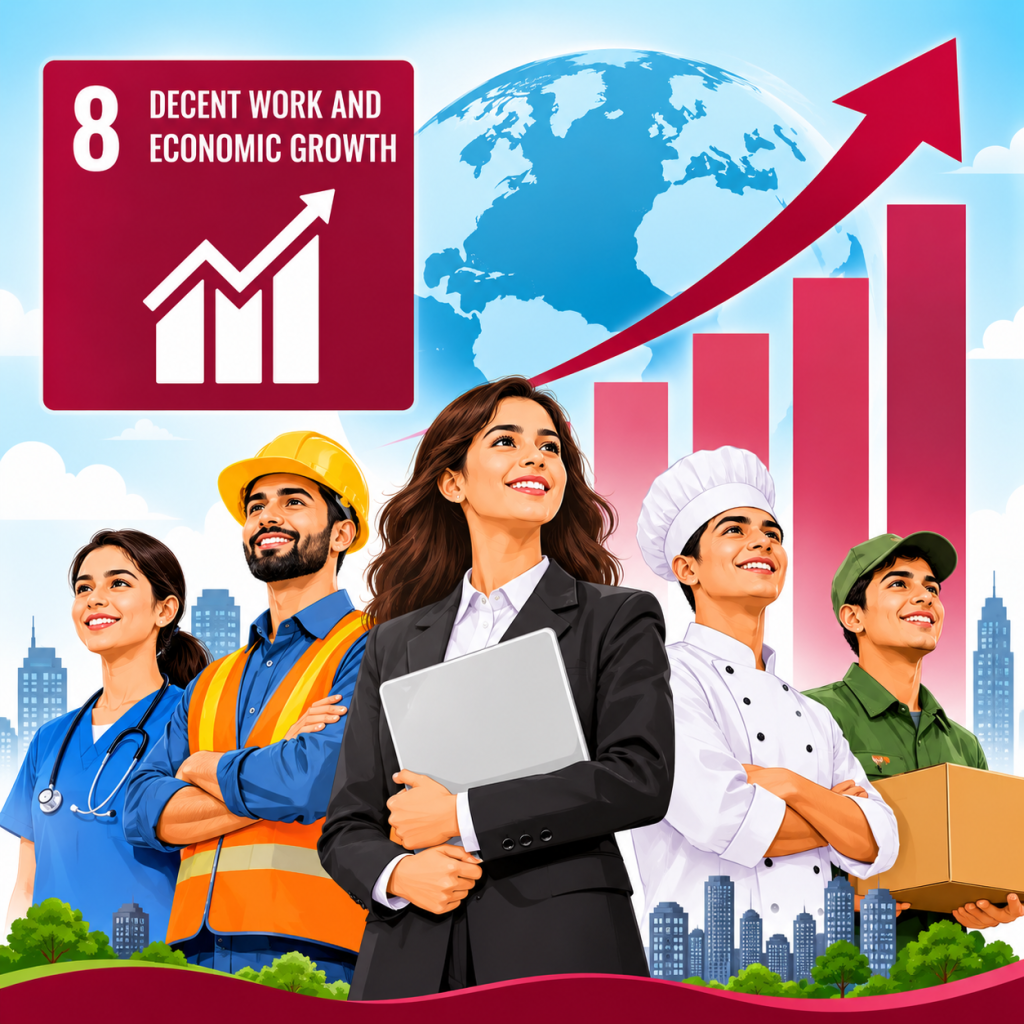
3. What Does Economic Growth Mean?
Economic growth is another central element of SDG 8. It refers to an increase in the production of goods and services within an economy over time. However, sustainable economic growth should also improve people’s living standards, create employment, and support long-term development.
Economic Growth Explained
Economic growth occurs when a country produces more goods and services than it did previously. It is commonly measured using Gross Domestic Product (GDP), which represents the total monetary value of final goods and services produced within a country during a specific period.
When GDP increases over time, it generally indicates that economic activity is expanding. However, GDP growth alone does not show whether income is distributed fairly or whether workers enjoy decent living conditions.
Several factors contribute to economic growth:
- Productivity: Producing more goods and services with available resources, technology, and labour.
- Investment: Businesses investing in equipment, infrastructure, technology, and employee development.
- Innovation: Developing new products, services, and production methods that improve efficiency.
- Job creation: Expanding businesses and industries that generate employment opportunities.
- Skills development: Improving workers’ knowledge and abilities to support a more productive workforce.
These factors are closely connected. For example, a manufacturing business that invests in modern machinery and employee training may increase production, improve product quality, and expand its workforce. This can contribute to business growth and the wider economy.
Why Growth Must Be Inclusive and Sustainable
Economic growth is most beneficial when its advantages reach different sections of society. Inclusive growth means that people from different income groups, genders, age groups, and communities have opportunities to participate in and benefit from economic development.
For example, a growing economy should provide employment opportunities for young people, support women entering the workforce, and help small businesses compete with larger companies.
Sustainable growth also considers the environmental and social consequences of economic activity. Businesses should not achieve higher profits by exhausting natural resources, creating excessive pollution, or exposing employees to dangerous working conditions.
This is particularly important because economic development depends on healthy communities, available resources, and a stable environment.
SDG 8 therefore encourages countries to increase productivity and economic output while using resources responsibly and protecting the interests of present and future generations. Department of Economic and Social Affairs+1
4. The Main Pillars of SDG 8
SDG 8 brings together several interconnected priorities that support economic development and improve employment conditions. These priorities can be understood through four broad themes: economic growth and productivity, employment and entrepreneurship, equality and workers’ rights, and safe and secure workplaces.
Together, these themes help establish an economy that is productive, fair, and socially responsible.
Economic Growth and Productivity
The first pillar focuses on building strong economies through sustainable growth, innovation, and improved productivity.
Countries can support this objective by investing in infrastructure, education, technology, and industries that generate economic opportunities. Businesses also play an important role by improving production processes, developing new products, and adopting more efficient technologies.
However, productivity improvements should benefit workers as well as businesses. Higher productivity can support better wages, business expansion, and additional employment opportunities when its benefits are shared fairly.
Employment and Entrepreneurship
The second pillar focuses on creating productive employment and supporting entrepreneurship.
Employment gives people opportunities to earn an income, develop professional skills, and participate in economic activities. Entrepreneurship creates additional opportunities by encouraging individuals to establish businesses, introduce innovative products, and provide services that meet market needs.
Small and medium-sized enterprises (SMEs) are particularly important because they contribute to employment and economic activity in many countries.
Governments can support this pillar by improving access to finance, providing business training, simplifying business registration, and creating an environment where new businesses can grow.
Equality and Workers’ Rights
Economic development should provide equal opportunities and protect the fundamental rights of workers.
This pillar promotes fair wages, equal pay for work of equal value, freedom from workplace discrimination, and protection against forced labour and exploitation.
It also encourages businesses to establish fair recruitment and promotion practices so that women, young people, people with disabilities, and other underrepresented groups can access employment opportunities.
Respecting workers’ rights creates a more inclusive labour market and helps businesses build trust with employees and communities.
Safe and Secure Workplaces
The fourth pillar focuses on protecting employees from workplace hazards and providing appropriate employment security.
Businesses should identify workplace risks, provide suitable protective equipment, maintain safe facilities, and train employees in health and safety procedures.
Social protection is equally important. Workers should have access to appropriate benefits and support during situations such as illness, maternity, disability, unemployment, and retirement.
Safe working conditions and reliable social protection improve employees’ well-being while supporting more stable and responsible business operations.
5. The 10 Major Targets of SDG 8
The United Nations has established specific targets under SDG 8 to guide governments, businesses, and international organisations towards decent work and sustainable economic growth.
The goal contains ten substantive targets, numbered 8.1 to 8.10, as well as two additional implementation targets, 8.a and 8.b. The following table summarises the ten main targets.
Overview of the 10 Major SDG 8 Targets
| SDG 8 Target | Main Focus |
|---|---|
| 8.1 | Sustainable economic growth |
| 8.2 | Productivity and innovation |
| 8.3 | Entrepreneurship and decent job creation |
| 8.4 | Resource efficiency and sustainable growth |
| 8.5 | Full employment, fair wages, and equal pay |
| 8.6 | Youth employment, education, and training |
| 8.7 | Ending forced labour, modern slavery, and child labour |
| 8.8 | Workers’ rights and workplace safety |
| 8.9 | Sustainable tourism and job creation |
| 8.10 | Access to banking and financial services |
Source: United Nations, Sustainable Development Goal 8. Department of Economic and Social Affairs+1
Understanding Each SDG 8 Target
Target 8.1: Sustainable Economic Growth
This target encourages countries to maintain economic growth according to their national circumstances. It also sets an ambition of at least 7% annual GDP growth for the least developed countries.
Target 8.2: Productivity and Innovation
This target promotes higher productivity through technological improvements, innovation, economic diversification, and the development of industries that generate greater economic value.
Target 8.3: Entrepreneurship and Decent Job Creation
This target encourages policies that support productive businesses, entrepreneurship, creativity, and innovation. It also promotes the formalisation and growth of micro, small, and medium-sized enterprises.
Target 8.4: Resource Efficiency and Sustainable Growth
This target focuses on improving the efficiency of resource consumption and production. It encourages countries to separate economic growth from environmental degradation through more sustainable production and consumption practices.
Target 8.5: Full Employment, Fair Wages, and Equal Pay
This target aims to achieve full and productive employment and decent work for women and men, including young people and persons with disabilities. It also promotes equal pay for work of equal value.
Target 8.6: Youth Employment, Education, and Training
This target originally aimed to substantially reduce the proportion of young people who are not in employment, education, or training by 2020. Although that deadline has passed, improving youth employment and access to education and skills development remains essential.
Target 8.7: Ending Forced Labour, Modern Slavery, and Child Labour
This target calls for immediate action against forced labour, human trafficking, modern slavery, and the worst forms of child labour. It also included an ambition to end child labour in all its forms by 2025, a milestone the world has unfortunately missed.
Target 8.8: Workers’ Rights and Workplace Safety
This target focuses on protecting labour rights and providing safe and secure working environments for all workers, including migrant workers and people in insecure employment.
Target 8.9: Sustainable Tourism and Job Creation
This target encourages sustainable tourism that creates employment opportunities, supports local businesses, and promotes local culture and products.
Target 8.10: Access to Banking and Financial Services
This target promotes stronger financial institutions and wider access to banking, insurance, and other financial services. Financial inclusion helps individuals and businesses manage money, save, invest, and access opportunities.
Two Additional Implementation Targets
In addition to the ten main targets, SDG 8 includes two targets that support their implementation.
- Target 8.a: Increase Aid for Trade support to developing countries, particularly least developed countries, to strengthen their participation in international trade.
- Target 8.b: Develop and operationalise a global strategy for youth employment and implement the ILO Global Jobs Pact.
These additional targets recognise that international cooperation, financial support, and employment policies are important for achieving decent work and sustainable economic growth worldwide. Department of Economic and Social Affairs+1

6. Global Challenges to Achieving SDG 8
Despite international efforts to improve employment conditions and strengthen economies, several challenges continue to slow progress towards SDG 8.
Unemployment, informal employment, workplace inequality, and labour exploitation affect millions of people. These problems are particularly serious in countries where economic opportunities, labour protections, and social security systems are limited.
Unemployment and Job Insecurity
Unemployment remains a major challenge for countries at different stages of economic development. It occurs when people who are available for work and actively seeking employment cannot find suitable jobs.
Young people often experience additional difficulties because they may lack professional experience, relevant skills, or access to employment networks.
Job insecurity is another concern. Some workers depend on temporary contracts, seasonal employment, or unpredictable working hours. Although these arrangements can provide income, they may not offer long-term financial stability or access to employment benefits.
The United Nations reported that the global unemployment rate reached approximately 5% in 2024. However, the global youth unemployment rate remained significantly higher, at 12.9%.
These figures demonstrate why economic development must focus not only on increasing employment but also on creating stable and productive opportunities. UNSD
Informal Employment and Low Wages
Informal employment refers to work that is not adequately covered by formal employment arrangements, labour regulations, or social protection systems.
Examples include street vending, unregistered small businesses, domestic work without formal contracts, and certain types of casual construction work.
Informal workers may experience several disadvantages:
- Limited access to healthcare, pensions, and unemployment benefits.
- Lack of formal employment contracts and legal safeguards.
- Unpredictable income and irregular working hours.
- Greater vulnerability to exploitation and unsafe working conditions.
Low wages create additional financial difficulties, particularly when workers cannot earn enough to cover housing, food, education, healthcare, and other essential expenses.
According to the United Nations’ 2025 SDG progress report, approximately 57.8% of the global workforce was informally employed in 2024. This means that more than half of workers worldwide lacked adequate coverage through formal employment and protection arrangements. UNSD+1
Inequality in the Workplace
Workplace inequality occurs when individuals do not receive equal opportunities, treatment, or compensation because of characteristics such as gender, age, disability, or social background.
The gender pay gap is one example. Women may receive lower average earnings than men, even when working in similar occupations. They may also experience barriers to leadership positions, career development, and employment opportunities.
Discrimination can also affect people with disabilities, migrant workers, and individuals from disadvantaged communities.
SDG 8 addresses these issues by promoting equal employment opportunities, fair treatment, and equal pay for work of equal value.
Businesses can contribute by introducing transparent recruitment processes, fair salary structures, inclusive workplace policies, and equal opportunities for professional development.
Child Labour and Forced Labour
Child labour and forced labour are serious violations of human rights that prevent people from enjoying safe and dignified working conditions.
This also refers to work that deprives children of their childhood, education, development, or health. It is particularly concerning when children are involved in dangerous activities or work that interferes with their schooling.
Forced labour occurs when individuals are compelled to work against their will under threats, coercion, debt bondage, or other forms of pressure.
Modern slavery and human trafficking are closely connected to these forms of exploitation.
According to the ILO’s 2024 global estimates, released in June 2025:
- Approximately 138 million children were engaged in child labour worldwide.
- Around 54 million children were involved in hazardous work that could harm their health, safety, or development.
Although the number of children in child labour declined by more than 22 million between 2020 and 2024, the figures demonstrate that substantial action is still required. International Labour Organization+1
Protecting vulnerable workers is essential to SDG 8 because economic growth cannot be considered sustainable when it depends on exploitation, unsafe employment, or the denial of fundamental human rights.
7. The Role of Businesses in Achieving SDG 8
Businesses play a significant role in achieving SDG 8 because they create employment, generate income, develop products and services, and influence working conditions across supply chains.
Their responsibility extends beyond making profits. Businesses should also ensure that their operations respect workers’ rights, provide fair employment opportunities, and contribute positively to society.
Responsible business practices can support economic development while improving the lives of employees and communities.
Creating Decent Employment
One of the most important ways businesses can support SDG 8 is by creating productive jobs with fair wages and secure employment conditions.
Employers should provide reasonable salaries, clear employment contracts, appropriate working hours, and equal opportunities for recruitment and promotion.
They should also avoid discriminatory hiring practices and ensure that employees are treated fairly regardless of their gender, age, disability, or background.
Supporting local employment and providing opportunities for young people can further strengthen communities and contribute to economic development.
Small and medium-sized businesses are particularly important because they create employment opportunities, encourage entrepreneurship, and support local economic activity.
Supporting Employees
Businesses should invest in employee well-being and professional development rather than viewing workers simply as resources for production.
Providing a supportive working environment can improve employee satisfaction, reduce staff turnover, and increase productivity.
Some practical ways businesses can support their employees include:
- Providing workplace health and safety training.
- Offering opportunities for professional development and skills improvement.
- Ensuring fair treatment and transparent performance evaluations.
- Supporting reasonable working hours and work-life balance.
- Providing appropriate leave arrangements and employee benefits.
- Encouraging communication between management and employees.
These practices help create workplaces where employees feel valued, respected, and motivated to contribute to business success.
Promoting Responsible Business Practices
Responsible business practices involve considering the social and environmental consequences of business decisions.
Companies should ensure that their own operations and supply chains respect labour standards. This is particularly important for industries such as clothing, agriculture, manufacturing, construction, and retail, where workers may face risks of exploitation.
For example, a clothing company should not focus only on purchasing products at the lowest possible price. It should also consider whether suppliers provide fair wages, safe working conditions, reasonable working hours, and protection against forced and child labour.
Businesses can support SDG 8 by:
- Conducting regular supplier assessments and labour audits.
- Establishing ethical recruitment and employment policies.
- Working with suppliers that respect international labour standards.
- Providing effective systems for employees to report workplace concerns.
- Improving transparency and accountability throughout supply chains.
By adopting these practices, businesses can strengthen their reputation, reduce operational risks, and contribute to more sustainable economic development.
8. Measuring Progress Towards SDG 8
Achieving SDG 8 requires more than setting employment and economic development goals. Governments and international organisations must also measure progress to understand whether policies and initiatives are producing meaningful results.
The United Nations tracks progress through a global framework of targets and indicators. These indicators help assess economic performance, employment opportunities, productivity, workplace equality, and workers’ rights.
The International Labour Organization also plays an important role by collecting and analysing labour statistics from countries around the world.
Key Indicators Used to Measure SDG 8
The following table highlights some important indicators used to evaluate progress towards decent work and economic growth.
Table: Key Indicators for Measuring SDG 8 Progress
| Indicator | What It Measures | Why It Matters |
|---|---|---|
| GDP growth per capita | Growth in economic output per person | Shows changes in economic performance and living standards |
| Labour productivity | Economic output produced per worker | Measures efficiency and productive capacity |
| Unemployment rate | Percentage of the labour force without employment but seeking work | Shows the availability of employment opportunities |
| Average hourly earnings | Average wages earned by employees | Helps assess income levels and equal pay |
| Youth NEET rate | Young people not in employment, education, or training | Highlights barriers to youth participation |
| Occupational injuries | Workplace injuries and fatalities | Measures workplace safety and employee protection |
| Informal employment | Workers employed in informal arrangements | Shows gaps in employment protection and social security |
Source: United Nations Global SDG Indicator Framework and ILO labour statistics. SDG Indicators+1
Why Measuring Progress Matters
Monitoring these indicators helps governments identify areas where employment policies and economic development strategies need improvement.
For example, an increase in GDP may indicate that an economy is expanding. However, if unemployment remains high or workers continue to experience low wages, the benefits of that growth may not be reaching society equally.
Similarly, a reduction in workplace injuries can indicate improvements in occupational health and safety, while a decline in informal employment may suggest that more workers are receiving formal contracts and legal protection.
These measurements also help businesses evaluate their employment practices and understand how their operations contribute to sustainable development.
Regular monitoring is essential because it allows governments, businesses, and international organisations to identify challenges, improve policies, and work towards the 2030 targets.
9. A Real-World Example of SDG 8 in Action
One practical example of SDG 8 in action is the Better Work Programme, a joint initiative of the International Labour Organization (ILO) and the International Finance Corporation (IFC).
The programme demonstrates how improving working conditions and protecting workers’ rights can also strengthen business performance and economic development.
What Is the Better Work Programme?
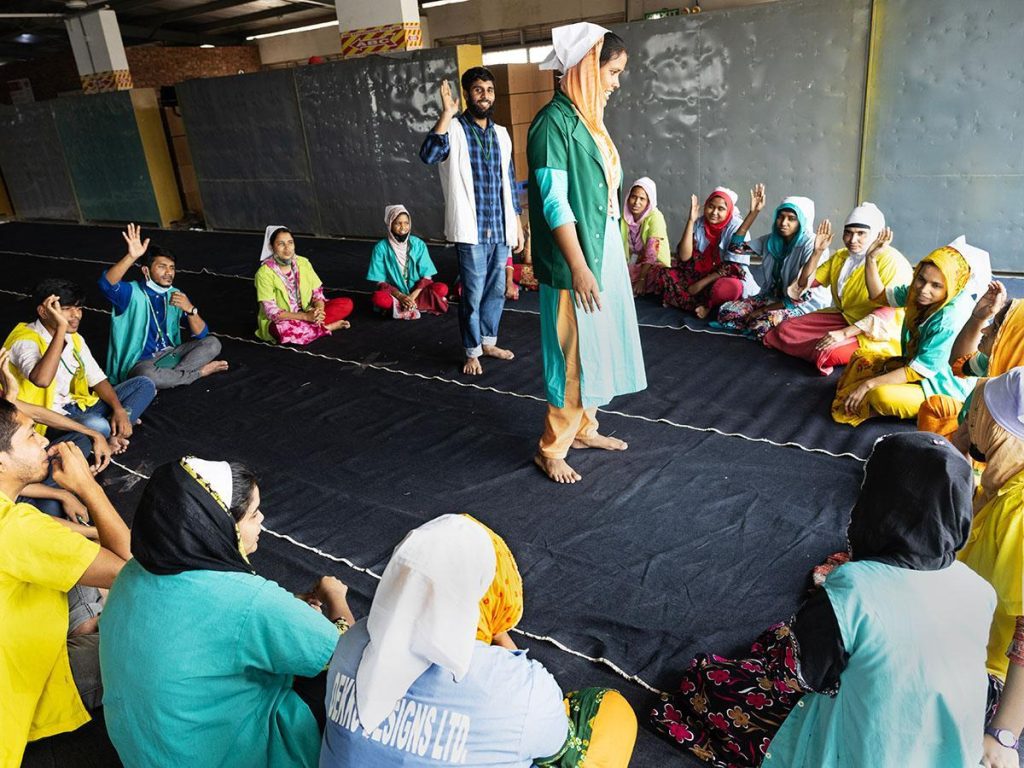
The Rana Plaza disaster ten years on: What has changed? – InfoStories
Better Work works with governments, international brands, factory owners, employers, and workers to improve labour standards and working conditions in the garment industry.
The programme provides factory assessments, advisory services, and training to help businesses identify workplace problems and introduce improvements.
Its activities focus on areas such as:
- Improving occupational health and safety.
- Promoting fair wages and working hours.
- Strengthening communication between workers and management.
- Addressing workplace discrimination and harassment.
- Improving compliance with national labour laws and international labour standards.
The initiative supports SDG 8 by showing that responsible employment practices can contribute to both worker protection and business competitiveness.
Better Work Pakistan: Supporting Workers and Businesses
A particularly relevant example is Better Work Pakistan, which supports improvements in the country’s textile and garment industry.
Pakistan’s garment sector provides employment to a large workforce and plays an important role in the country’s export economy. Improving working conditions in this industry can therefore benefit employees, businesses, and the wider economy.
According to a United Nations Pakistan update published in July 2026, an assessment of Better Work Pakistan’s pilot phase from 2022 to 2025 identified several positive outcomes among participating factories.
The findings included:
- More than two-thirds of participating factories reported improvements in worker productivity after joining the programme.
- Around two-thirds reported improvements in worker morale, occupational safety and health, and relationships between workers and management.
- Approximately 60% reported moderate to significant improvements in market access, business risk management, and reduced duplication of buyer audits.
These findings demonstrate how improving labour standards can also support business competitiveness and operational performance. United Nations in Pakistan+1
Who Benefits from the Initiative?
Better Work Pakistan provides benefits to several groups.
Workers: Employees benefit from improved workplace safety, stronger communication channels, better awareness of labour rights, and improved working conditions.
Businesses: Factory owners can improve productivity, strengthen management practices, reduce workplace risks, and build stronger relationships with international buyers.
Communities: Better employment conditions and more responsible business operations can contribute to household financial security and wider economic development.
The national economy: A stronger and more responsible garment industry can support export competitiveness, employment, and long-term industrial development.
The Better Work example demonstrates that decent work and economic growth are not competing priorities. Businesses can improve their performance while respecting workers’ rights and supporting sustainable employment.
10. Conclusion: Building a Better Future Through SDG 8
Decent Work and Economic Growth is an essential part of sustainable development because it connects economic progress with people’s rights, opportunities, and quality of life.
SDG 8 recognises that a strong economy should do more than increase production, business profits, or national income. It should also create productive employment, provide fair wages, protect workers, and ensure that economic opportunities are accessible to everyone.
Throughout this article, we have explored the importance of decent work, the relationship between productivity and economic growth, the ten major SDG 8 targets, and the challenges that continue to affect workers worldwide.
We have also seen how businesses can contribute through responsible recruitment, fair employment practices, workplace safety, employee development, and ethical supply chains.
However, achieving SDG 8 requires cooperation beyond individual businesses. Governments must establish and enforce effective labour policies, businesses must respect workers’ rights, and communities must support inclusive economic opportunities.
As the world moves towards the 2030 deadline, creating a fairer and more sustainable economy requires a shared commitment to ensuring that economic development benefits people as well as businesses.
Ultimately, true economic progress is not simply about creating more wealth. It is about creating better opportunities, protecting workers, and building an economy in which everyone has the opportunity to thrive.