
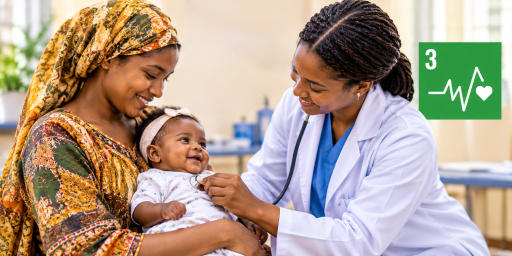
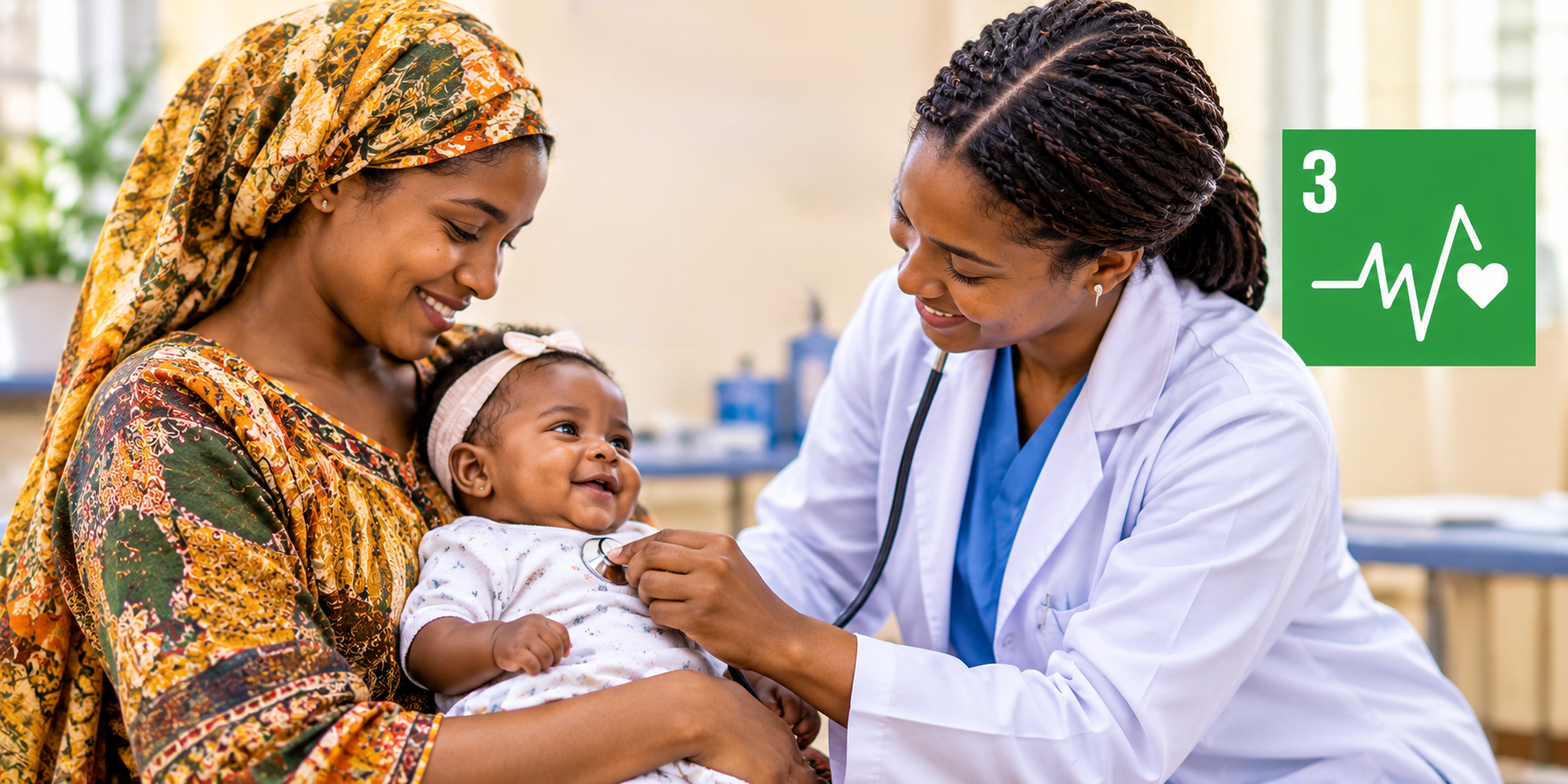
Every two minutes, a woman dies from complications of pregnancy or childbirth. Most of these deaths are preventable, which is why maternal health sits at the heart of public health. In 2023 alone, WHO and its UN partners estimate 260,000 maternal deaths. Maternal health protects women, newborns, and the families who depend on them. When mothers thrive, communities grow stronger.
SDG 3, Good Health and Well Being, puts this issue at the center. Target 3.1 aims to cut the global maternal mortality ratio to under 70 deaths per 100,000 live births by 2030. This guide explains the challenges, the solutions, and the next steps. For the bigger picture, read our overview of SDG Goal 3.
Understanding Maternal Health
Maternal health is the health of women during pregnancy, childbirth, and the weeks after delivery. Quality care at each stage saves lives.
During pregnancy. Antenatal care tracks blood pressure, nutrition, and the baby’s growth. Early checks catch risks such as preeclampsia and anaemia.
During childbirth. A skilled attendant manages labour and acts fast when complications arise. Haemorrhage remains the leading cause of maternal death worldwide, so speed matters.
After delivery. Postnatal visits address bleeding, infection, newborn feeding, and emotional wellbeing. Too often, this stage gets overlooked.
Why check ups matter. Regular check ups turn hidden risks into manageable ones. For example, a mother with high blood pressure can receive treatment before it becomes an emergency.
Why skilled birth assistance matters. Midwives and doctors recognise danger signs early. UNICEF reports that skilled professionals assisted 86 percent of births globally in 2023. However, that average hides large regional gaps.
Challenges in Maternal Healthcare
Even where services exist, many women cannot use them. Four barriers stand out.
Limited access to facilities. Many women live far from the nearest clinic. In Sub Saharan Africa, only 64 percent of births take place in health facilities, according to UNICEF.
Affordability. Fees, transport costs, and medicine bills push families toward delivering at home. As a result, many women skip antenatal visits.
Lack of trained professionals. Midwife and doctor shortages leave clinics understaffed. Remaining staff often cover wide areas with few supplies.
Delays in emergency care. Experts describe three delays: deciding to seek help, reaching a facility, and receiving quality care on arrival. Any one can be fatal when bleeding starts.
Maternal Health in Developing Countries
Mothers in low income communities face far greater risks. Over 90 percent of maternal deaths occur in low and lower middle income countries, according to WHO. Sub Saharan Africa alone accounts for about 70 percent.
Three barriers drive this gap:
- Poverty. Families cannot afford fees, transport, or time away from work.
- Distance. Roads are poor and ambulances are scarce. In 2023, skilled staff attended 93 percent of urban births but only 77 percent of rural births.
- Limited healthcare resources. Clinics may lack blood supplies, trained staff, or reliable electricity.
Therefore, closing these gaps matters more than improving national averages.
The Role of Technology
Technology can shorten the distance between mothers and care. Three tools stand out.
Telemedicine. A midwife in a remote clinic can share symptoms or scan images with a city obstetrician. Advice then arrives in minutes, not days.
Mobile health services. Text messages remind women about antenatal visits. Community health workers can also alert an ambulance with one message.
Digital health records. Records follow the mother across clinics. Providers see her history, so they spot risks sooner and avoid repeated tests.
Rwanda shows how this works in practice, as the next section explains. Still, technology cannot fix a weak health system. It multiplies the impact of trained people.
A Case Study
Rwanda’s RapidSMS programme offers a credible example.
The approach. Community health workers received mobile phones to register pregnancies and report births. The system also sent emergency alerts to ambulance services and health facilities.
The early results. In a pilot in Musanze district, 432 community health workers were trained. Facility deliveries rose from 72 percent to 92 percent in twelve months. Rwanda then scaled the system nationwide in 2013.
The wider picture. Rwanda’s maternal mortality ratio fell from 750 per 100,000 births in 2005 to 210 by 2015. By then, 91 percent of women delivered in a health facility. Many factors drove this decline, so RapidSMS deserves part of the credit, not all of it.
The lesson. A later evaluation found RapidSMS alone did not improve service use. However, it worked when paired with training, supervision, and equipment. In short, technology succeeds when the health system backs it.
Measuring Progress Toward SDG 3
The world has made real gains. Since 2000, the global maternal mortality ratio fell about 40 percent. It dropped from 328 to 197 deaths per 100,000 live births in 2023.
However, progress has slowed significantly since 2016. At the current pace, the 2030 ratio will be more than twice the SDG 3.1 target.
Two indicators show where to act:
- Skilled birth attendance. Indicator 3.1.2 tracks whether trained professionals attend deliveries. Coverage has grown, yet poorer regions still lag.
- Access to essential maternal services. This includes antenatal visits, emergency obstetric care, and postnatal checks. Gaps here cost lives.
Better data helps too. Countries that record births and deaths accurately can direct resources where mothers need them most.
What Governments and Businesses Can Do
Governments set the foundation. Businesses extend it.
Governments can:
- Invest in primary care, midwives, and emergency transport.
- Remove fees that keep poor families away. This supports universal health coverage.
- Train and keep more skilled birth attendants, especially in rural areas.
Businesses can:
- Offer paid maternity leave and flexible return to work plans.
- Cover antenatal and postnatal care in employee health plans.
- Provide lactation rooms and safe work adjustments during pregnancy.
Partnerships multiply impact. A company might fund mobile clinics run by a hospital or NGO. Our guide on partnerships for the SDGs shows how such alliances work. Likewise, women’s health connects directly to gender equality and economic growth.
Conclusion
Maternal health is essential to achieving SDG 3. Every preventable death signals a gap in care, funding, or access. Rwanda shows that smart investment and strong community health systems change outcomes.
Looking ahead, the 2030 deadline is close. Progress now requires faster action, better data, and shared responsibility. Above all, every mother deserves accessible, affordable, and quality maternal healthcare. When we deliver it, healthier families and stronger economies follow.
References
- WHO, UNICEF, UNFPA, World Bank Group and UNDESA, Trends in Maternal Mortality 2000 to 2023 (2025)
- UNICEF Data, Delivery Care and Skilled Birth Attendance (2023 data)
- Ngabo et al., RapidSMS MCH pilot in Rwanda, Pan African Medical Journal (2012)
- Musabyimana et al., Rwanda RapidSMS evaluation, PLOS ONE (2018)
- Health Policy and Planning, impact of mHealth monitoring on service use in Rwanda (2018)