


More than 700 million people still live on less than $2.15 a day. Despite decades of economic progress, poverty remains one of the most persistent challenges of our time. That is precisely why SDG 1 and social protection systems have become inseparable pillars of the global development agenda. Together, they offer a structured, actionable framework for eliminating extreme poverty and building long-term economic resilience. As the 2030 Agenda deadline approaches, understanding how these two forces interact is not simply a matter of policy — it is a matter of survival for hundreds of millions of people worldwide.
Social protection systems serve as the backbone of any serious poverty reduction effort. They connect vulnerable populations to the resources, healthcare, and financial support they need to recover from economic shocks. Furthermore, they create the stable conditions in which sustainable development can genuinely take root. This article explores how SDG 1 and social protection systems reinforce each other, what challenges stand in the way, and what the future holds for poverty resilience on a global scale.
Understanding SDG 1: No Poverty
SDG 1, the first of the United Nations’ 17 Sustainable Development Goals, carries a straightforward but enormously ambitious mandate: end poverty in all its forms, everywhere. However, the goal goes far beyond simply raising income levels. It targets the structural conditions that keep people trapped in deprivation across generations.
The key objectives of SDG 1 include:
- Eradicating extreme poverty for all people living on less than $1.90 per day by 2030
- Reducing by at least half the proportion of men, women, and children living in poverty
- Implementing nationally appropriate social protection systems for all
- Ensuring equal rights to economic resources, basic services, and financial inclusion
- Building resilience among the poor to reduce their exposure to climate and economic shocks
As explored in our detailed overview of the SDG Goal 1: No Poverty, poverty is not purely about income. It encompasses lack of access to education, healthcare, clean water, and legal rights. Consequently, long-term sustainability goals under SDG 1 must address all of these dimensions simultaneously. Without systemic change, short-term income transfers alone will not break the cycle of vulnerability.
What Are Social Protection Systems
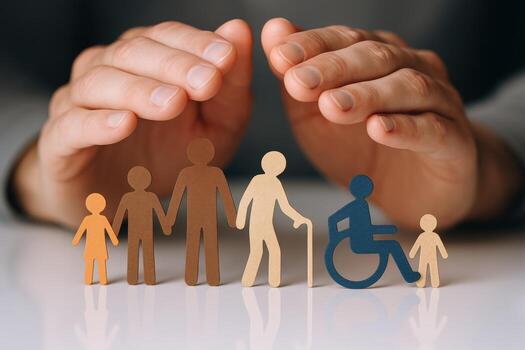
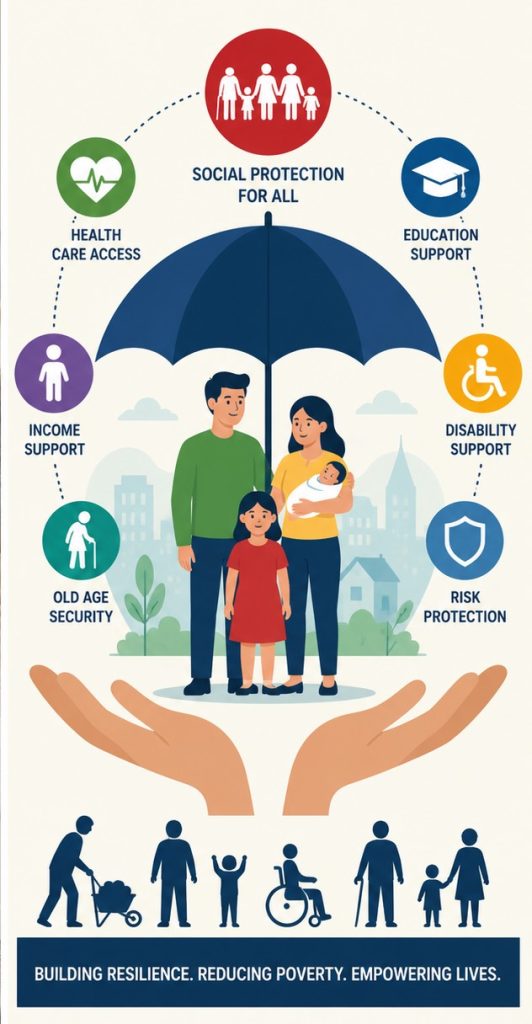
Social protection systems are coordinated sets of policies and programs designed to prevent, reduce, and eliminate economic and social vulnerability. They form the safety net that catches individuals and families when they fall — and ideally, they provide the ladder to help them climb out.
These systems typically include:
- Social safety nets: Cash transfer programs, food assistance, and housing subsidies that address immediate needs
- Healthcare coverage: Universal or subsidized health services that prevent medical costs from pushing families into poverty
- Unemployment benefits: Income replacement programs that support workers during periods of job loss
- Pension and disability schemes: Long-term support for elderly and differently-abled populations
- Child and family allowances: Targeted support to reduce childhood poverty and improve educational outcomes
Inclusive protection policies are essential because they must reach informal workers, migrants, and rural communities — groups that standard welfare programs often miss. Therefore, effective social protection is not merely about what programs exist, but about whether those programs actually reach the people who need them most. For broader context on why these structures matter, see our post on sustainable development goals and their role in global progress.
How SDG 1 and Social Protection Systems Work Together
The relationship between SDG 1 and social protection systems is direct and measurable. Social protection reduces economic vulnerability by providing a financial floor below which living standards cannot fall. This function is critical because economic shocks — whether from job loss, illness, or climate disasters — are the primary triggers that push families into extreme poverty.
Consider the case of Brazil’s Bolsa Família program. At its peak, this conditional cash transfer program reached over 14 million families. It required recipients to keep children in school and attend regular health checkups. The result was a measurable reduction in child poverty and improved long-term health outcomes — demonstrating precisely how social protection advances SDG 1 targets through multiple pathways simultaneously.
Beyond cash transfers, social protection supports low-income communities by improving quality of life and stability. When people are not constantly managing immediate survival, they can invest time and resources into education, small businesses, and community participation. This creates an upward spiral of development rather than the vicious cycle of poverty. Furthermore, stable households contribute more productively to local economies, generating broader growth that benefits the entire community.
Role of Governments in SDG 1 and Social Protection
Governments are the primary architects of social protection systems. Their role encompasses policy development, resource allocation, and program delivery across diverse populations. Without strong political commitment and adequate funding, even the best-designed systems will fail to reach those who need them most.
Effective national poverty reduction strategies generally include three interconnected layers. First, governments must enact legal frameworks that establish the right to social protection as a universal entitlement rather than a discretionary benefit. Second, they must invest in the administrative infrastructure needed to identify, register, and serve eligible populations. Third, they must fund these systems sustainably — which often requires progressive taxation, international development finance, or public-private partnerships.
Public welfare initiatives also benefit from alignment with broader development frameworks. Countries that integrate social protection into their national SDG reporting and investment strategies tend to achieve more coherent and lasting results. As discussed in our post on SDG reporting and investments, transparent accountability mechanisms are essential for ensuring that government commitments translate into real outcomes for vulnerable populations.
Technology and Digital Access in Social Protection
Digital transformation is reshaping how social protection systems deliver services — and therefore how effectively they advance SDG 1 and social protection goals on the ground. Digital welfare systems allow governments to register beneficiaries more accurately, disburse payments instantly, and reduce administrative corruption that has historically undermined traditional welfare programs.
Data-driven support programs use real-time information to identify who is most at risk and intervene proactively. For example, satellite data and mobile phone records can flag communities affected by floods or droughts before traditional assessment teams arrive. As a result, relief can reach affected households faster and more efficiently than ever before. Similarly, biometric identification systems have dramatically reduced duplicate registrations and ghost beneficiaries in several Sub-Saharan African programs.
Improving accessibility and transparency through digital platforms also builds public trust. When beneficiaries can check their payment status via mobile phone, and when civil society can monitor program statistics through open data portals, accountability increases significantly. However, digital access must itself be treated as a prerequisite — not an assumption — for these systems to work equitably. Read more about how technology supports sustainable outcomes in our article on the intersection of sustainability and digital transformation.
Challenges in Strengthening Social Protection
Despite clear progress, significant challenges continue to limit the reach and effectiveness of social protection systems. Addressing these barriers is essential for realizing the full potential of SDG 1 by 2030.
Funding limitations remain the most fundamental constraint. Low-income countries spend, on average, less than 1.5% of GDP on social protection, compared to over 15% in high-income nations. This creates a paradox: the countries with the greatest poverty challenges invest the least in protection systems.
Unequal access to services compounds this problem. Informal workers — who make up over 60% of the global workforce — are frequently excluded from contributory pension and unemployment schemes. Women, indigenous communities, and people with disabilities face additional layers of exclusion rooted in systemic discrimination.
Administrative and infrastructure barriers further reduce effectiveness. In many regions, the absence of reliable civil registration systems means that millions of people lack the legal identity required to access benefits. Poor road networks and unreliable electricity supply limit service delivery in remote areas. Overcoming these barriers requires not just funding, but coordinated investment in foundational systems across multiple sectors.
Global Approaches to Poverty Resilience
Globally, the most successful approaches to poverty resilience combine community-based support with international development frameworks. Community-based systems leverage local knowledge, social trust, and informal networks to reach populations that formal government programs miss. Village savings groups, community health workers, and mutual aid organizations all play critical roles in extending the protective net.
International development initiatives from organizations such as the World Bank, ILO, and UNICEF have supported national governments in designing and scaling social protection systems. Notably, the Social Protection Inter-Agency Cooperation Board (SPIAC-B) coordinates these efforts to avoid duplication and promote coherence across programs. Additionally, south-south cooperation — where middle-income countries share expertise with lower-income partners — is proving highly effective in transferring practical program management knowledge.
Sustainable social investment models go one step further by integrating social protection into long-term economic planning. Rather than treating welfare as a cost, these models demonstrate that every dollar invested in social protection generates measurable returns through improved health outcomes, higher educational attainment, and greater workforce productivity. For a broader look at how SDGs drive global change, explore our post on the 17 SDGs roadmap for global change.
Future of SDG 1 and Social Protection
Looking ahead, the future of SDG 1 and social protection systems lies in smart, adaptive, and inclusive designs that can respond to a rapidly changing world. Climate change, automation, and demographic shifts are creating new forms of vulnerability that existing systems were not built to handle. Therefore, innovation is not optional — it is urgent.
Smart welfare systems will use artificial intelligence and predictive analytics to anticipate poverty risks before they materialize. By combining health data, employment records, weather forecasts, and economic indicators, these systems can activate targeted interventions proactively. However, these technologies must be governed by strong ethical frameworks to prevent discrimination and protect data privacy.
Inclusive economic resilience strategies will increasingly focus on asset-building rather than income replacement alone. Microfinance, land rights, digital skills training, and access to financial services are all elements of a comprehensive approach that moves people from dependency toward economic agency. Finally, a long-term sustainable development outlook requires that social protection systems be adequately financed, politically insulated from short-term budget pressures, and firmly grounded in human rights principles. As we explore in our article on SDG 1 and financial inclusion, economic access is the true bridge between poverty relief and lasting prosperity.
Conclusion
The connection between SDG 1 and social protection systems is not coincidental — it is structural. Social protection provides the foundation on which No Poverty can be realistically achieved. Without robust, inclusive, and well-funded welfare systems, the ambitious targets of SDG 1 will remain aspirational rather than attainable. The evidence is clear: countries that invest in comprehensive social protection see faster poverty reduction, greater economic stability, and more resilient communities.
The need for inclusive and resilient systems has never been more urgent. As the world faces compounding crises — from climate shocks to economic inequality — social protection must evolve from a reactive safety net into a proactive platform for human development. Ultimately, achieving SDG 1 by 2030 will require collective action from governments, international organizations, civil society, and the private sector. The path forward is clear. What remains is the political will and investment to walk it.