


More than 700 million people still live on less than $2.15 a day. Despite decades of global development efforts, poverty remains one of the most persistent challenges of our time. At the heart of solving this crisis lies a powerful, often underestimated lever — SDG 1 and sustainable employment. Together, these two pillars form the backbone of any credible strategy for lasting poverty reduction. Employment doesn’t just generate income; it restores dignity, builds resilience, and creates the economic stability that communities need to thrive over the long term.
Understanding SDG 1: No Poverty
The United Nations’ first Sustainable Development Goal is clear in its ambition: end poverty in all its forms, everywhere, by 2030. However, SDG 1 goes far beyond setting an income threshold. It calls for equal rights to economic resources, access to basic services, and the protection of vulnerable populations from economic shocks and environmental disasters.
Globally, progress has been uneven. While East Asia made remarkable strides in the early 2000s, sub-Saharan Africa and parts of South Asia continue to face deeply structural poverty traps. Moreover, the COVID-19 pandemic reversed years of gains, pushing an estimated 93 million additional people into extreme poverty between 2020 and 2021.
From a sustainable development perspective, eliminating poverty is not simply about redistributing wealth. It requires building systems — economic, social, and institutional — that generate opportunity consistently and equitably. Therefore, SDG 1 is fundamentally connected to how economies create and sustain jobs.
What Is Sustainable Employment
Sustainable employment refers to work that is stable, fairly compensated, and environmentally and socially responsible. It goes well beyond simply having a job. Instead, it reflects the International Labour Organization’s concept of “decent work” — employment that respects workers’ rights, provides a living wage, ensures safe conditions, and offers pathways for advancement.
Key characteristics of sustainable employment include:
- Fair and living wages that cover basic needs without requiring multiple jobs
- Job security with formal contracts and legal protections
- Access to social protection, including healthcare and pensions
- Opportunities for skills development and career growth
- Environmental responsibility, ensuring jobs don’t come at the cost of ecological health
Consequently, sustainable employment is not just good for workers — it is also good for businesses. Companies that invest in their workforce consistently report lower turnover, higher productivity, and stronger community relationships.
How Employment Supports SDG 1
The relationship between employment and poverty reduction is direct and measurable. When individuals earn a reliable income, they can meet basic needs, invest in their children’s education, and build savings that buffer against future shocks. This progression is central to achieving SDG 1.
Furthermore, sustainable employment reduces economic inequality by broadening access to income across demographics. Women, rural populations, and marginalized communities — who are disproportionately affected by poverty — benefit most from employment policies that actively include them.
Consider Bangladesh’s garment sector as a practical example. Over the past three decades, the industry has employed millions of women who previously had limited economic participation. As a result, female literacy rates improved, household incomes rose, and child poverty declined significantly in communities connected to the sector. While challenges around working conditions persist, the example illustrates how targeted employment growth can directly advance SDG 1.
Empowering vulnerable communities through employment also reduces dependence on aid and strengthens local economies from within — creating a self-reinforcing cycle of development.

Role of Businesses in Sustainable Employment
Businesses are not just beneficiaries of a stable economy. They are, in fact, its primary architects. Companies that adopt ethical hiring practices — avoiding discrimination, paying fair wages, and offering clear progression pathways — directly contribute to SDG 1.
Workforce development is another critical area. Businesses that invest in training programs, apprenticeships, and upskilling initiatives close skills gaps that would otherwise keep workers locked out of quality employment. Additionally, inclusive employment strategies — actively recruiting from underrepresented groups including people with disabilities, refugees, and former welfare recipients — expand the talent base while reducing systemic exclusion.
Multinationals, in particular, bear a significant responsibility. Their supply chain decisions affect millions of workers in low-income countries. By setting and enforcing labor standards throughout their supply chains, global companies can drive systemic improvements in employment quality far beyond their direct workforce.
Technology and the Future of Employment
Digital transformation is reshaping the labor market at an unprecedented pace. On one hand, automation threatens to displace low-skilled workers — precisely those most vulnerable to poverty. On the other hand, technology is also creating entirely new categories of employment, many of which are accessible remotely and at lower entry costs than traditional industries.
Green jobs represent one of the most promising intersections of technology and sustainable employment. Renewable energy, sustainable agriculture, circular economy manufacturing, and eco-tourism are generating millions of positions globally. According to the International Renewable Energy Agency, the energy transition could create 30 million new jobs by 2030 — most of which can be designed from the ground up to meet decent work standards.
Skills development, therefore, becomes a national and organizational priority. Governments and businesses that invest proactively in digital literacy, technical vocational training, and green economy competencies will position their workforces to benefit from — rather than be displaced by — technological change.
Challenges in Achieving Sustainable Employment
Despite clear progress in some regions, significant obstacles remain. Skills gaps are among the most persistent. In many developing economies, educational systems are not producing graduates equipped for the demands of a modern labor market. As a result, employers struggle to fill technical roles while unemployment remains high.
Economic instability compounds this problem. Currency volatility, inflation, debt crises, and climate-related disruptions regularly derail employment gains — particularly in lower-income countries that lack fiscal buffers. Moreover, workforce inequality remains deeply entrenched. Women earn approximately 20% less than men globally, and workers in the informal economy — which accounts for over 60% of global employment — often have no access to legal protections or social security.
Accessibility is also a challenge. People with disabilities, indigenous communities, and remote populations face compounded barriers to formal employment. Without deliberate policy intervention, these groups are consistently left behind in economic growth narratives.
Global Strategies for Poverty Reduction Through Employment
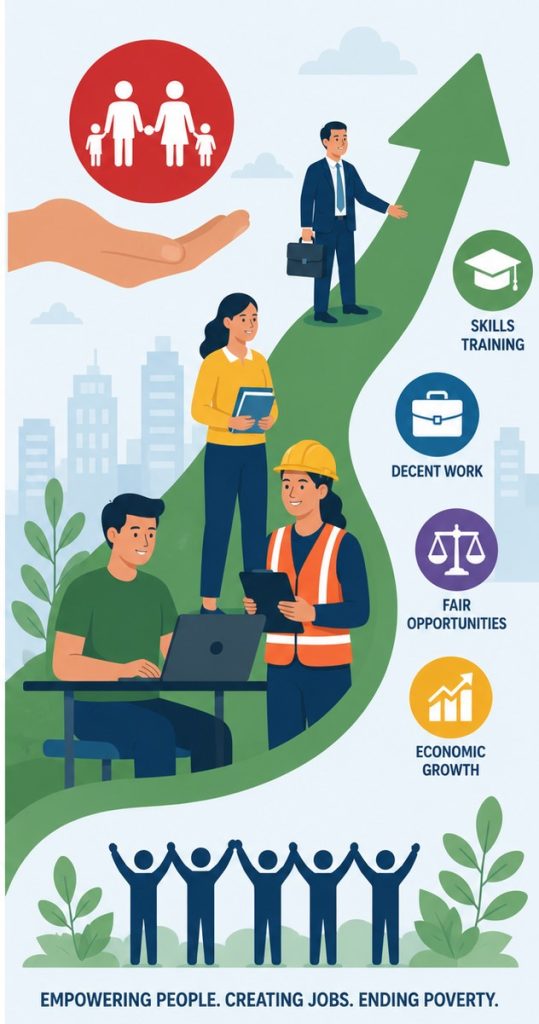
Addressing these challenges requires coordinated strategies at multiple levels. Public-private employment initiatives have shown particular promise. Governments that offer tax incentives for businesses creating jobs in high-poverty areas — combined with corporate commitments to local hiring — can produce rapid, targeted employment growth.
Community development programs also play a vital role. Microfinance schemes, cooperatives, and local enterprise support networks have enabled millions of individuals in low-income settings to create self-sustaining livelihoods. Organizations like the BRAC in Bangladesh have demonstrated that combining skills training, seed funding, and mentorship can lift entire communities out of poverty within a single generation.
Sustainable economic growth models — those that balance GDP expansion with ecological limits and social equity — are increasingly being adopted by forward-thinking governments. Countries like Costa Rica and Denmark have demonstrated that it is entirely possible to maintain high employment rates while prioritizing environmental and social outcomes simultaneously.
Future of SDG 1 and Sustainable Employment
Looking ahead, the future of SDG 1 and sustainable employment will be shaped by innovation, inclusion, and institutional resilience. Emerging technologies such as artificial intelligence, biotechnology, and advanced manufacturing will generate new workforce opportunities — but only for those equipped with the right skills and given equitable access to them.
Inclusive economic systems are, therefore, not optional. They are the foundation upon which any meaningful progress toward SDG 1 must be built. This means designing labor markets, education systems, and social protection frameworks that actively account for gender, geography, and socioeconomic status.
Long-term resilience requires moving beyond short-term job creation metrics. The goal must be to build economies in which sustainable employment is the norm — where workers at every level have security, opportunity, and agency. As climate pressures intensify, this will also mean preparing communities for the economic transitions ahead, ensuring that no one is left behind in the shift to a green economy.
Conclusion
SDG 1 and sustainable employment are not parallel goals — they are inseparable ones. Meaningful progress on poverty requires the creation of jobs that are stable, fair, and built to last. Governments, businesses, and civil society must work together with urgency and intention to dismantle the structural barriers that keep millions from accessing economic opportunity.
The path forward demands more than incremental policy adjustments. It calls for a fundamental shift in how we value work, design economies, and measure success. By placing sustainable employment at the center of development strategies, the global community can transform SDG 1 from an ambitious target into a lived reality — for every person, in every corner of the world.
Related reading: Explore how sustainable business practices connect to broader SDG frameworks on blog.fherist.com.